

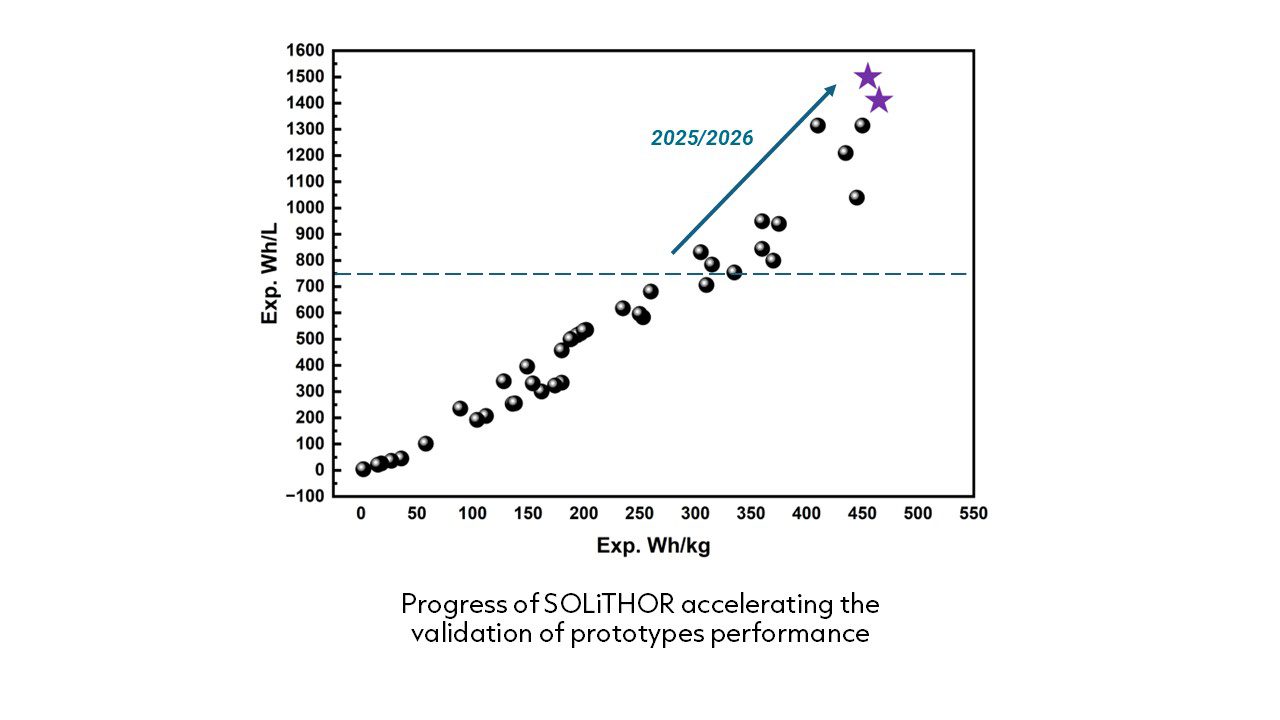
Belgian battery startup SOLiTHOR has published a technical update showing that its sol-gel Solid Composite Electrolyte has reached 465 Wh/kg and 1,400 Wh/L at stack level in a multilayer pouch design—achieved by impregnating the electrolyte into a high-loading cathode with an areal capacity of 8 mAh/cm². The result requires no liquid electrolyte, which the company says is the central distinction from competing semi-solid and hybrid approaches.
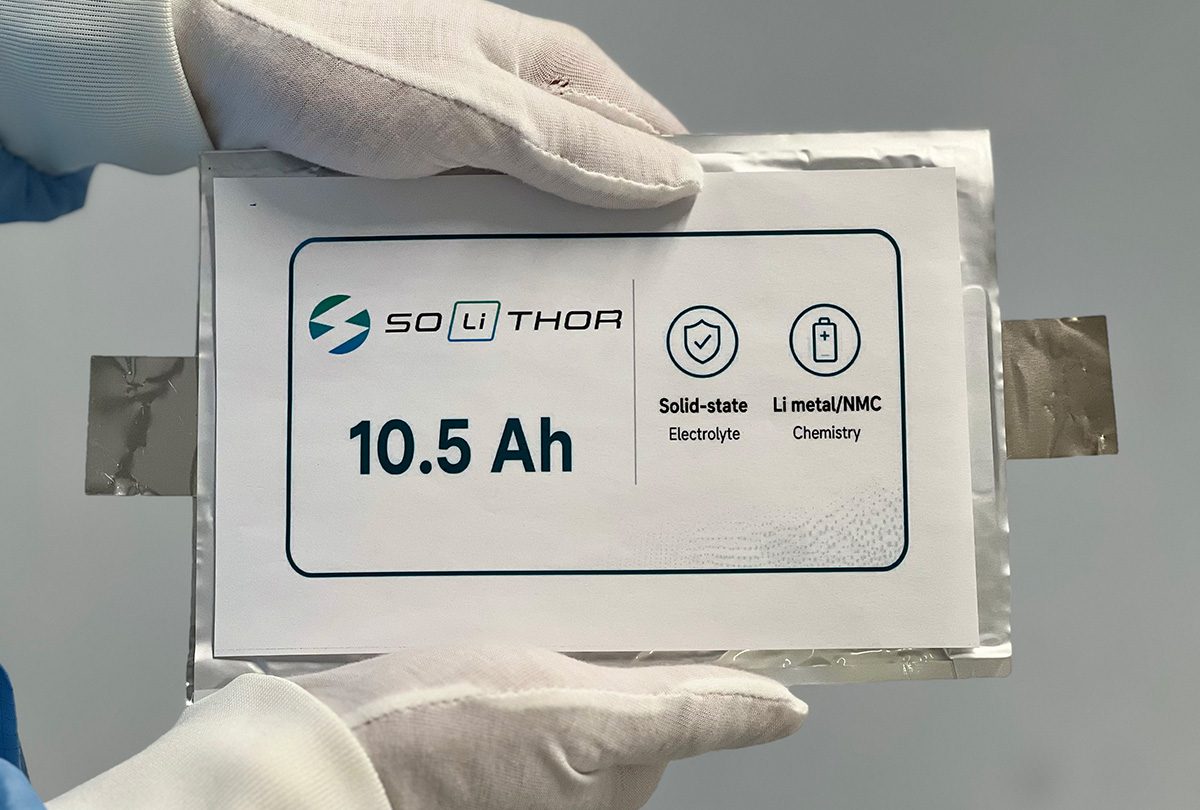
In multilayer pouch cells tested at 25 °C, the technology has demonstrated continuous discharge at up to 5C with minimal capacity loss and pulse discharge at 10C for 30 seconds at 50% state of charge. Cycle life in a 1 Ah multilayer pouch cell exceeds 500 discharge cycles with more than 80% initial capacity retention. SOLiTHOR has also produced its first 10 Ah demonstration cell as a scalability checkpoint.
The cell passed overcharge and nail penetration tests at 100% charge with no smoke, leakage, thermal runaway or fire.
SOLiTHOR’s process is roll-to-roll compatible and eliminates the electrolyte-filling step entirely, while reducing formation and aging time by two thirds, according to the company. Those two steps can account for up to 25% of current Li-ion processing costs. The company says existing Li-ion production lines can be upgraded for its solid-state process without new equipment.
Applications include aerospace, dual-use defense and mobility. SOLiTHOR has received its first defense funding through the DEEP-TECH project under the European Defence Fund for deep-sea autonomy applications.
“These technical achievements not only prove that the chemistry works, but that it delivers the combination of energy density, power performance and cycle life required for practical applications,” said Dr. Fanny Bardé, co-founder and CTO at SOLiTHOR. “The achievements also highlight our ability to accelerate development, with faster iterations and more effective impact on performance.”
Source: SOLiTHOR



















 EV Engineering Webinars & Whitepapers








 EV Tech Explained