

Lider Electric’s NEMA 14-50 receptacles with Electric Vehicle Marking combine certification-backed product identification with purpose-built EV charging design.
EV charging reliability is often discussed at the system level: charger output, vehicle compatibility, software, utility capacity, and public infrastructure. Those factors matter, but many residential and light commercial charging setups still depend on a physical component that can be easy to overlook: the receptacle.
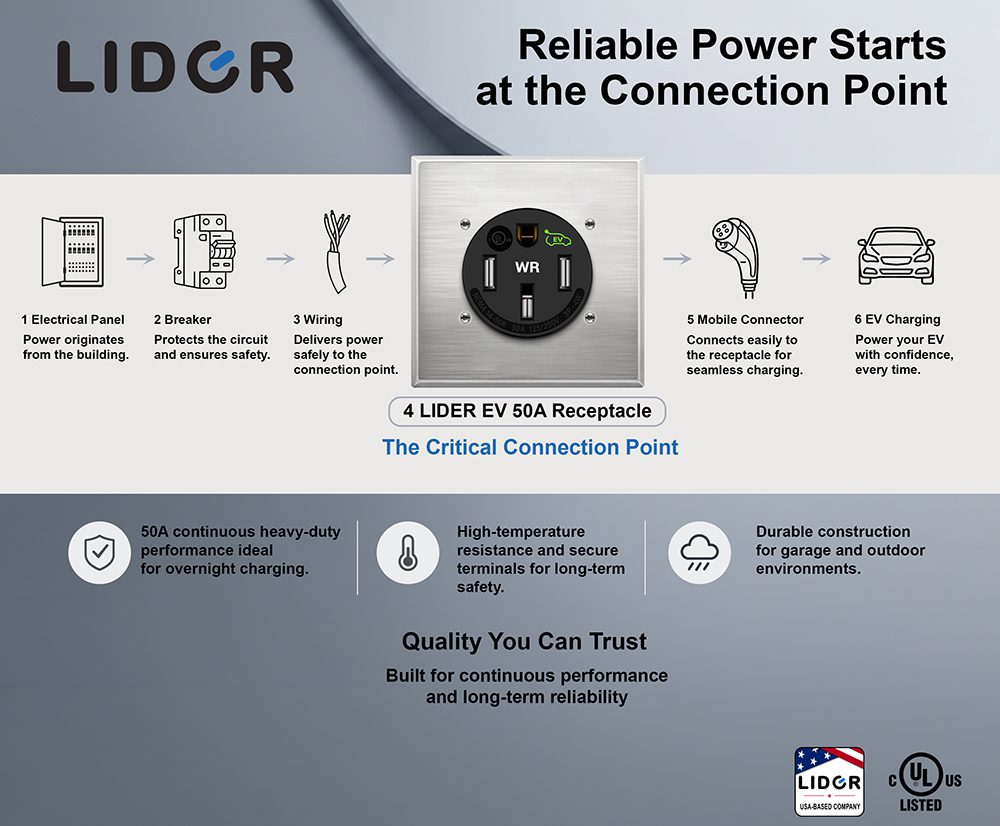
For plug-in Level 2 charging, the NEMA 14-50 receptacle is where the building’s electrical system meets the charging equipment. It is the point where wiring, contact pressure, mechanical fit, heat, repeated use, and installation quality all come together. From the outside, it may look like a standard wiring device. In daily EV charging, it becomes part of the charging infrastructure.
That connection point is the focus behind Lider Electric’s LN-1450RH and LN-1450RHW NEMA 14-50 receptacles. The latest UL certification documentation identifies these models with Electric Vehicle Marking, giving installers and customers a clearer way to recognize their EV-related certification status. Together, the certification, marking, and product design reflect Lider Electric’s focus on safety-conscious product development, connection reliability, and long-term charging performance.
Why EV Charging Changes the Role of the Receptacle
EV charging is not a one-time electrical event. For many drivers, it is a repeated duty cycle: plug in, charge for hours, unplug, and repeat. That pattern places sustained demand on the electrical pathway, especially in garages, driveways, workshops, multifamily properties, and light commercial environments.
In that environment, product selection should go beyond plug configuration and price. A receptacle used for EV-related applications should be evaluated with daily use, sustained electrical load, secure wiring connections, heat management, and long-term durability in mind.
The receptacle also does not work alone. Breaker selection, wire sizing, grounding, enclosure selection, terminal torque, local code compliance, and qualified installation all matter. But the receptacle is where electrical performance becomes physical contact, making it an important part of the overall charging setup.
Designed for Sustained EV Charging Use
Lider Electric’s approach to NEMA 14-50 receptacle design starts with how EV charging is actually used. It is designed around repeated charging sessions, sustained electrical demand, and the need for reliable connection performance over time.
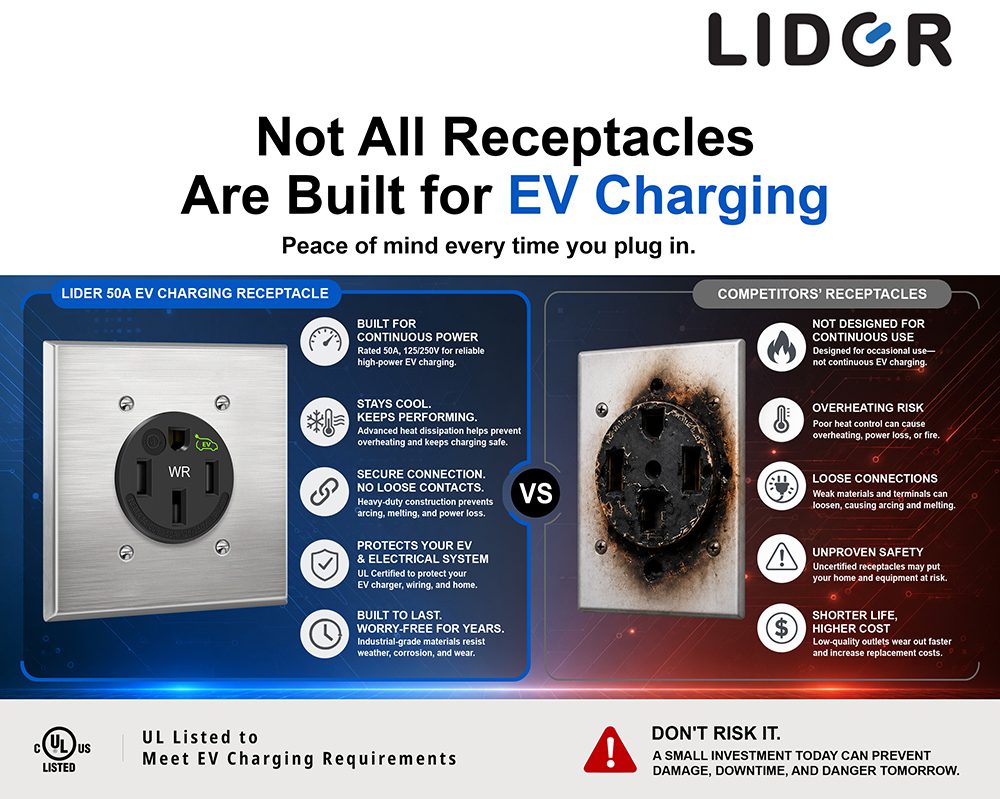
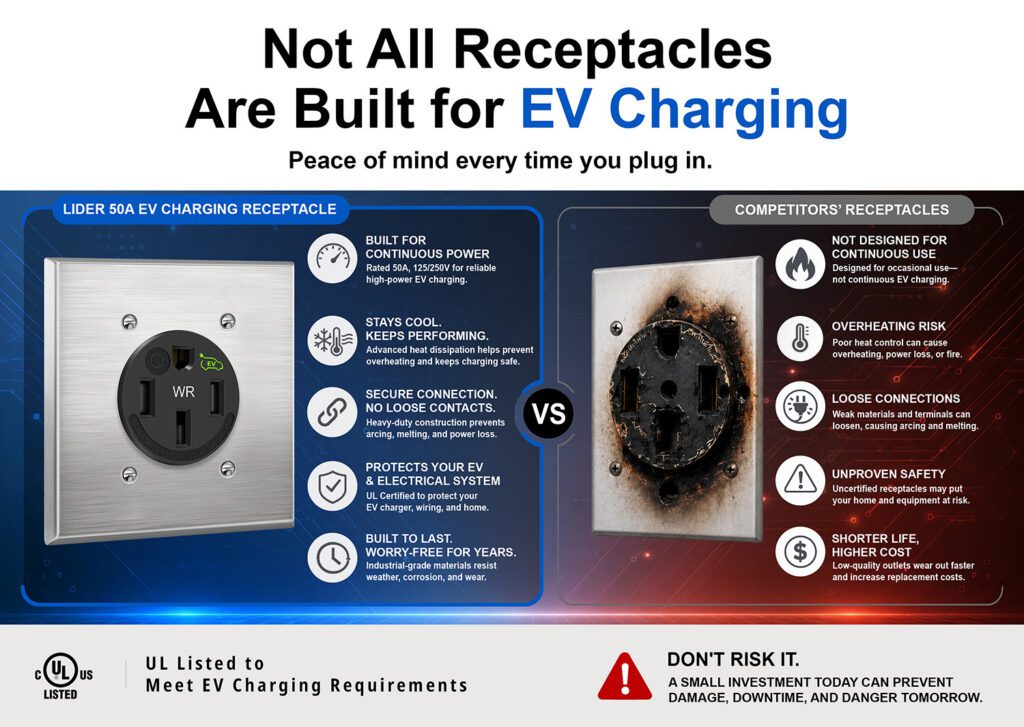
The LN-1450RH and LN-1450RHW are rated 50A, 125/250V and engineered for EV-related installations where long-duration charging performance matters. Their design priorities include reliable power at the connection point, heavy-duty NEMA 14-50 construction, secure connection performance under sustained electrical load, contacts designed to support heat resistance during extended use, and clear product identification through Electric Vehicle Marking.
That matters in a market where products can appear similar in online listings. Two receptacles may share the same configuration, but differ in internal construction, contact design, material selection, terminal strength, and certification status. For installers and buyers, those details can influence how confidently a product is selected for an EV-ready electrical upgrade.
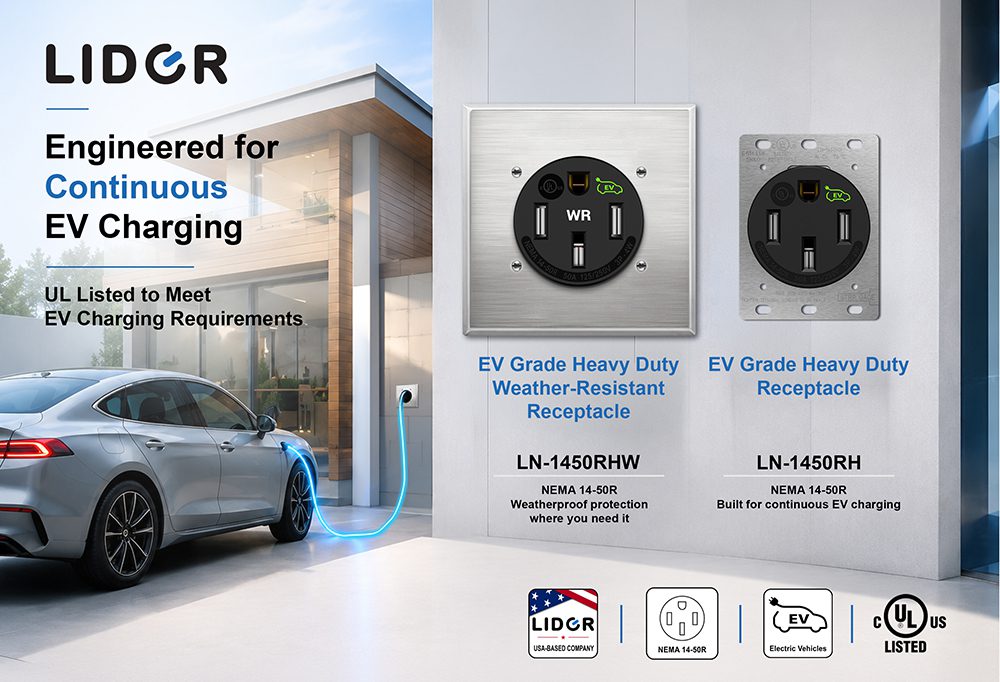
Lider Electric’s position is straightforward: for daily EV charging, product selection should not be based on price and plug configuration alone. The company focuses on engineering, materials, safety-conscious product development, and dependable performance so EV owners and trade professionals can make more informed decisions at the connection point.
Inside the Engineering
Lider Electric’s EV charging receptacle design focuses on internal components that support stable connection performance under sustained use. Key design details include:
- Fortified nylon enclosure reinforced with glass fibers to support durability, heat resistance, and wear resistance
- Silver-plated solid H65 brass contacts designed for conductivity and resistance to oxidation
- V-shaped high-purity ETP copper clamp with Cu ≥ 99.9%, designed to hold stranded and solid wires securely
- Max 75 lb-in torque hexagon terminal screws designed to support secure installation when installed according to applicable requirements and professional practices
- Self-grounding design to help provide a reliable ground path when properly installed
- Electric Vehicle Marking for clearer product identification in EV-related applications
These engineering choices reflect the same principle that shapes the broader product design: EV charging reliability starts with the quality of the physical connection.
The Difference Between Claims and Certification
The EV charging market includes many products that claim to meet applicable standards. However, there is an important distinction between a self-declared claim and a product that has completed the applicable certification process. In practical terms, certification matters because it gives installers and customers a documented basis for product evaluation, as long as the certification reference matches the authorized UL Mark and certification scope.
For homeowners, commercial users, electricians, contractors, builders, and EV installation professionals, that distinction matters. UL certification provides a clearer reference point when evaluating products for EV-ready residential and commercial projects. It helps move the buying decision beyond marketing copy and toward documented certification.
For Lider Electric’s LN-1450RH and LN-1450RHW, the latest certification documentation identifies a NEMA 14-50 receptacle platform with Electric Vehicle Marking. Electric Vehicle Marking helps identify receptacles that have been evaluated under UL certification requirements for EV-related use. For installers, inspectors, and customers, it is more than a label; it is a practical product identification tool in a category where clarity is increasingly important.
According to the UL Certificate of Compliance, representative samples of Lider Electric’s LN-1450RH-** and LN-1450RHW-** have been evaluated by UL in accordance with the Standard(s) indicated on the Certificate. For the U.S. Listing, the certificate references “UL 498 – Attachment Plugs and Receptacles.” The Models section specifies “LN-1450RH-** Electric Vehicle Marking – Suitable for USL only” and “LN-1450RHW-** Electric Vehicle Marking – Suitable for USL only.”
Lider Electric has shared more background in Lider Electric’s UL certification announcement and its EV Marking Article, including how certification documentation supports clearer product identification for EV-related applications.
What This Means for the Field
For electricians and EV installation professionals, clear product identification can support more consistent specification and selection. When a receptacle is marked and documented for EV-related use, it gives installers another reference point when planning a charging setup.
For builders and property managers, EV readiness is becoming part of long-term property planning. Selecting components designed around real charging behavior can support more future-ready electrical projects.
For EV owners, the takeaway is simple: dependable charging begins before the vehicle is plugged in. It starts with the electrical pathway, the quality of the installation, and the reliability of the receptacle at the connection point.
Built Around a More Demanding Charging Future
As EV adoption continues to grow, expectations for charging infrastructure should grow with it. Charging speed and convenience will remain important, but so will the quality of the components behind the wall. The receptacle may be small compared with the charger or the vehicle, but it plays a meaningful role in supporting daily charging performance.
Lider Electric’s NEMA 14-50 receptacles with Electric Vehicle Marking reflect that approach. The LN-1450RH and LN-1450RHW are designed for EV charging environments where connection reliability, product identification, secure installation, and long-term performance matter.
For readers evaluating NEMA receptacle options for EV-ready projects, Lider Electric provides a broader overview through the LIDER NEMA receptacle collection. Those looking for model-specific details can review the LN-1450RH product page or the LN-1450RHW product page. Customers who prefer marketplace purchasing can also view the LN-1450RHW on Amazon.
Reliable power starts at the connection point. For Lider Electric, that is where thoughtful EV charging design begins.












 Webinars & Whitepapers






 EV Tech Explained