
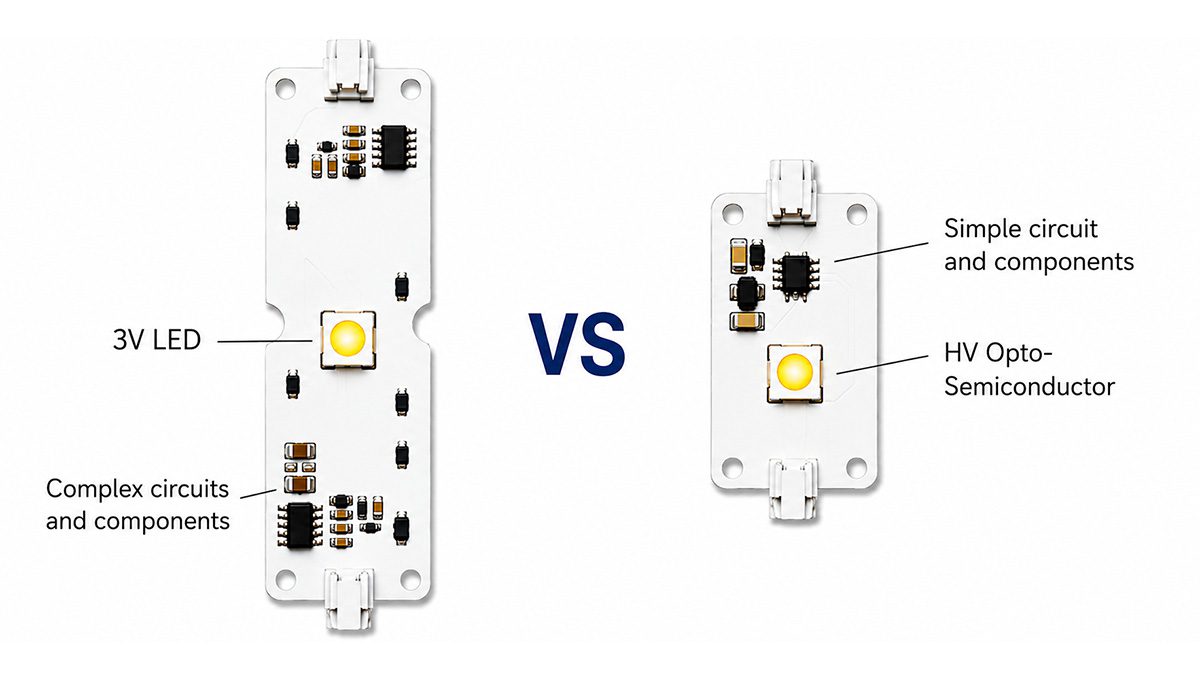
Seoul Semiconductor says its 12 V High Voltage (HV) opto-semiconductor technology has entered mass production with four unnamed automotive brands across the Americas, Europe and Asia. The company plans to deploy the technology in 10 vehicle models by year-end.
The technology addresses a voltage mismatch problem that’s grown more acute in EVs and hybrids. Conventional automotive LED systems run at 3 V, but EV battery packs typically operate at 300 V. That 1/100 voltage step-down ratio requires significant conversion circuitry—adding components, generating heat and losing energy in the process.
Seoul Semiconductor’s approach uses a Multi-Junction P-N structure to enable single-chip operation at 12–30 V, which reduces the conversion ratio to 1/10 and cuts conversion losses substantially. The result is a simpler PCB design with fewer driver components, less heat, and better durability. Compared to conventional 3 V LEDs, the company claims a 20% reduction in driver costs, a 10% reduction in power consumption, and a 10% reduction in overall driver-related component count.
The company pairs its HV opto-semiconductor chips with its own high-voltage driver technology and holds hundreds of HV chip patents and more than 50 HV driver patents.
“Global electrified vehicle sales—including hybrids—are set to surpass 20 million units this year, and that number is expected to double to 40 million units in five years,” said Matthew Fras, COO of North America Sales. “As vehicles become more functionally advanced, the value of opto-semiconductors per vehicle is also projected to grow from $100 to $200, meaning the overall opto-semiconductor market will expand fourfold.”
Source: Seoul Semiconductor


















 EV Engineering Webinars & Whitepapers


















 EV Tech Explained