


Samsung Electro-Mechanics is mass-producing a new set of ultra-high-voltage multilayer ceramic capacitors (MLCCs) rated from 1000 V to 1500 V, extending its C0G and X8G temperature-stable series to cover 800 V EV inverter systems and next-generation onboard chargers.
All four devices share a 1210 package (3.2×2.5 mm) and hold capacitance within 0±30 ppm/°C across the operating range—C0G specified from –55 to 125 °C, X8G from –55 to 150 °C. Capacitance runs from 1.2 nF at 1500 V to 33 nF at 1000 V. Three of the four carry a fail-safe design designation.
| Part Number | Capacitance | Rated Voltage | TCC |
|---|---|---|---|
| CL32G122KVV3PN# | 1.2 nF | 1500 V | X8G |
| CL32C103JXV3PN# | 10 nF | 1250 V | C0G |
| CL32C223JIV3PN# | 22 nF | 1000 V | C0G |
| CL32C333JIV1PN# | 33 nF | 1000 V | C0G |
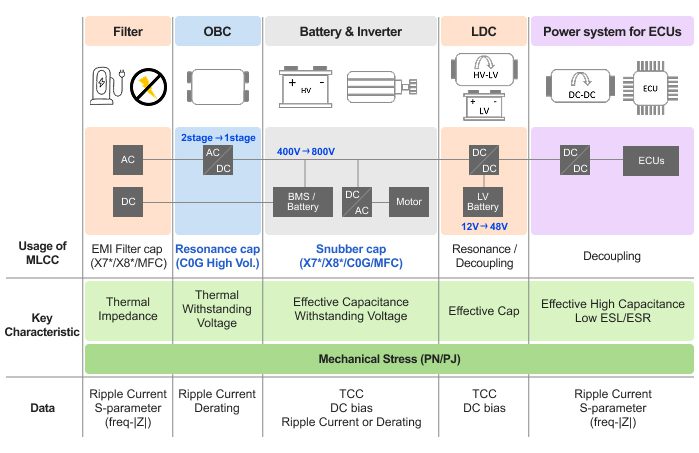
The target applications are the resonant tank circuits (CLLC topology) in EV charging systems and snubber capacitors for suppressing switching transients in inverter power modules. As next-gen OBC output power climbs beyond 22 kW, component voltage and capacitance requirements rise with it—higher-voltage, stable-dielectric MLCCs let designers maintain power density without sacrificing reliability.
C0G and X8G dielectrics deliver near-zero capacitance drift over temperature. That matters in resonant converter designs because capacitance directly sets the resonant frequency; any drift shifts the operating point and affects efficiency. Extending this level of stability to 1000–1500 V is what the 800 V powertrain generation demands.
The parts are in mass production. Samsung Electro-Mechanics offers technical support and samples for customer-specific designs.
Source: Samsung Electro-Mechanics


















 EV Engineering Webinars & Whitepapers

 EV Tech Explained