

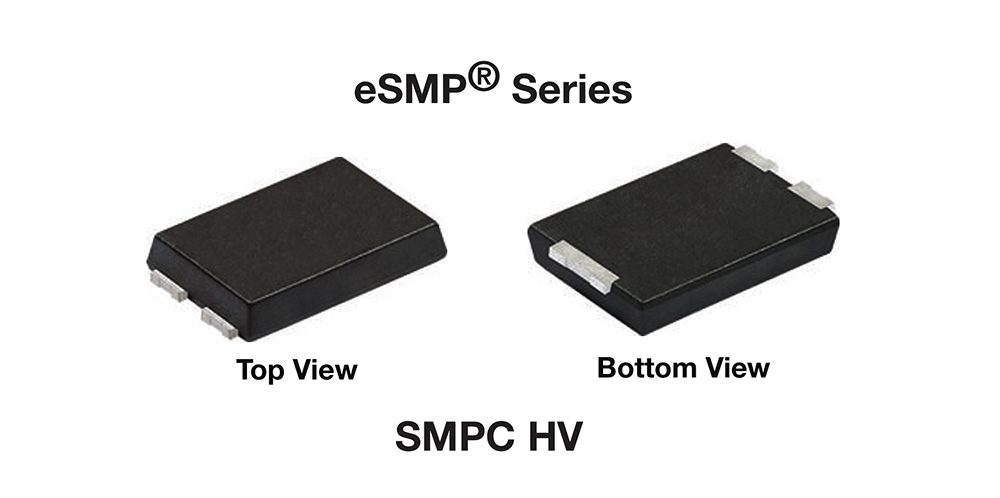
Vishay Intertechnology has added six diodes to its Gen 7 family of 1200 V FRED Pt Hyperfast rectifiers, all built in the company’s eSMP-series SMPC HV package. Rated at 1 A, 2 A and 3 A, the parts combine a low reverse recovery charge and a low forward voltage drop to trim switching losses in industrial, automotive and energy designs.
The new parts are the VS-E7SX0112-M3V, VS-E7SX0212-M3V and VS-E7SX0312-M3V, plus three AEC-Q101 qualified versions: the VS-E7SX0112HM3V, VS-E7SX0212HM3V and VS-E7SX0312HM3V. Across the range, recovery time runs to 50 ns, reverse recovery charge (Qrr) drops to 105 nC typical, forward voltage falls to 1.45 V and junction capacitance reaches 7.25 pF. Non-repetitive peak surge current goes up to 70 A. The package measures 4.3 mm x 6.5 mm, stands just 1.1 mm tall and is footprint-compatible with the TO-277A.
A lower Qrr means the diode releases less stored charge each time it switches off, so less energy is wasted per cycle, the loss that dominates in high-frequency converters. Recovery losses climb with switching frequency, so the lower charge pays off most in fast-switching power stages. The planar structure and platinum-doped lifetime control hold down the stored charge and recovery current behind switching loss and power dissipation. Vishay says the six parts offer the best Qrr-to-forward-voltage trade-off in their class, along with the lowest junction capacitance and recovery time.
A minimum 5.4 mm creepage distance and a molding compound rated at a comparative tracking index of 600 or higher (Material Group I) let the diodes meet IEC 60664-1 spacing rules for high-voltage circuits, which the company says trims component counts and BOM cost.
In use, the rectifiers work as clamp, snubber and freewheeling diodes in flyback auxiliary supplies, as high-frequency rectifiers for bootstrap driver stages, and as desaturation protection for fast-switching IGBTs and high-voltage Si and SiC MOSFETs. Vishay points to industrial drives and tools, EV on-board chargers and motors, energy generation and storage, and cuk converters and LED SEPIC circuitry as typical applications.
The diodes are RoHS-compliant and halogen-free, carry a moisture sensitivity level of 1 under J-STD-020 and operate at temperatures up to 175° C. Samples and production quantities are available now, and the lead time is eight weeks.
Source: Vishay Intertechnology



















 EV Engineering Webinars & Whitepapers








 EV Tech Explained