



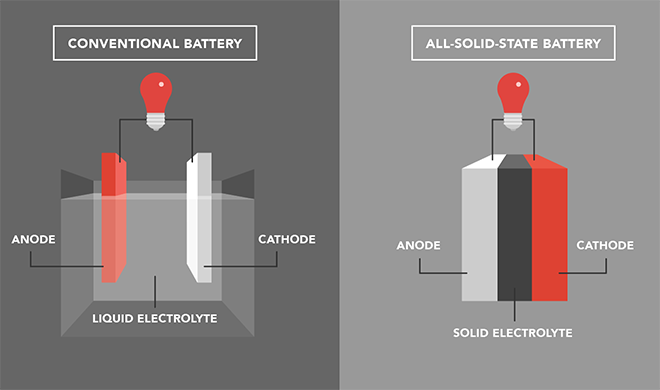
Researchers at Hanyang University have identified 2.5 nanometers as the minimum coating thickness required to effectively protect cathode materials in sulfide-based all-solid-state batteries—giving the field a quantitative lower bound it has been missing.
The study focused on lithium niobium oxide (LNO) coatings applied to NCM811 cathode powders via rotary powder atomic layer deposition. Sulfide-based solid electrolytes are chemically reactive at the cathode interface—they generate resistive degradation products on contact with cathode active materials, shortening cycle life. Thin LNO coatings act as a diffusion barrier, but the minimum thickness required to actually suppress those side reactions hadn’t been established.
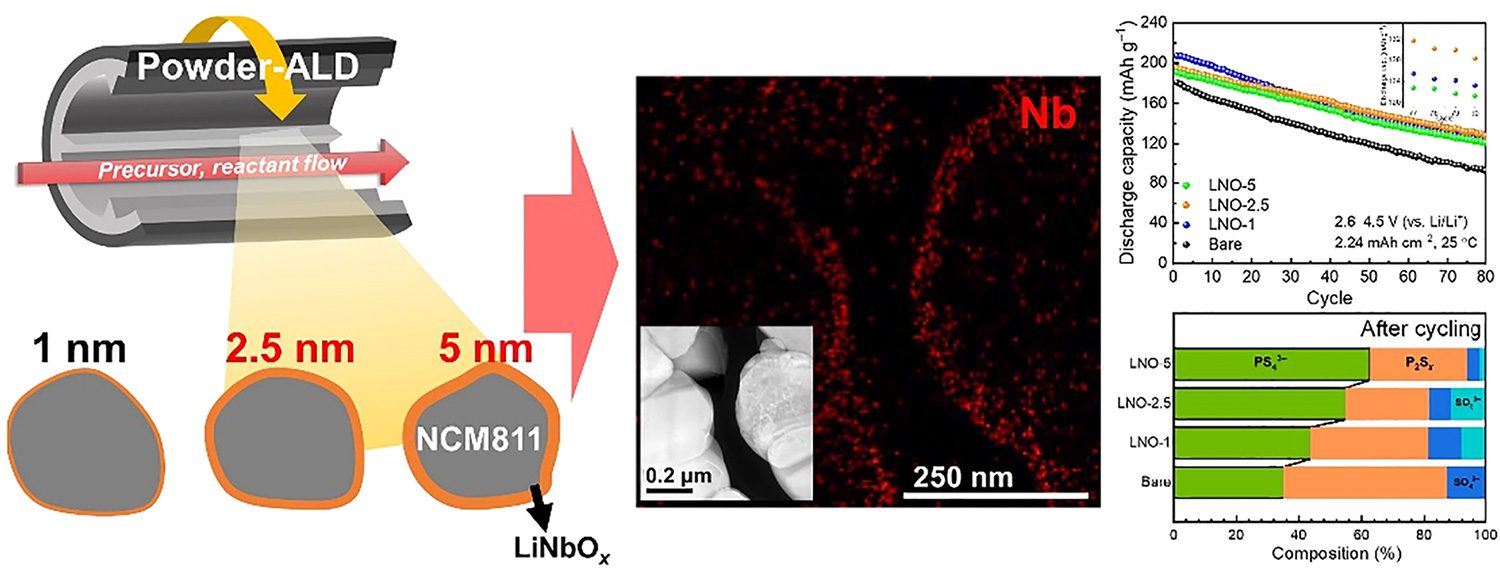
The Hanyang team deposited LNO at three thicknesses—1.0 nm, 2.5 nm and 5.0 nm—using a supercycle ALD method that alternates lithium and niobium deposition with ozone for precise composition control. The resulting cells showed a clear trade-off. The 1.0 nm coating delivered the highest initial discharge capacity at 229 mAh g⁻¹, but cycle life ran 28% shorter than the 2.5 nm cells and interfacial resistance was 59% higher. Spectroscopic analysis confirmed that side reactions were effectively suppressed at 2.5 nm but not at 1.0 nm—the coating was simply too thin to prevent electrolyte contact. The 2.5 nm cells achieved 216 mAh g⁻¹ initial capacity; going to 5.0 nm dropped that further to 207 mAh g⁻¹ with no meaningful cycle life gain.
Against an uncoated cell, the 2.5 nm coating extended cycle life by 43% and cut interfacial resistance to less than half.
“Our results show that the minimum effective thickness of the LNO protective layer to suppress side reactions in sulfide-based ASSBs is 2.5 nm,” said Prof. Tae Joo Park, who led the research. “This provides a practical guideline for cathode–electrolyte interface optimization in next-generation solid-state batteries.”
The team notes that powder ALD is promising for scalable manufacturing, though gigafactory integration remains an open challenge. The study was published in Energy Storage Materials.
Source: Hanyang University / Energy Storage Materials




















 EV Engineering Webinars & Whitepapers











 EV Tech Explained