

Forbidden fruit tastes sweetest, ‘tis said. Chinese EVs, which by all accounts are as good as or better than anything US automakers have to offer, are taboo to US buyers (but soon, not to Canadians). However, American early-adopter types are developing a taste for them, thanks to internet influencers.
Bloomberg reports that an annual survey by research firm Strategic Vision found that a third of US new-vehicle buyers said they’d consider buying a vehicle built in China.
About a year ago, car guy Richard Benoit, host of the Rich Rebuilds YouTube channel, flew to Alaska to test-drive several of China’s latest EVs, and raved about them in a video entitled “I drove the cheap Chinese cars that are illegal in the USA. Now I know why.” The video has gotten 2 million views, and Benoit says his US subscribers lap up everything he posts about Chinese EVs. “The second I mention a Chinese car, the videos skyrocket,” Benoit told Bloomberg. “Americans want these cars.”
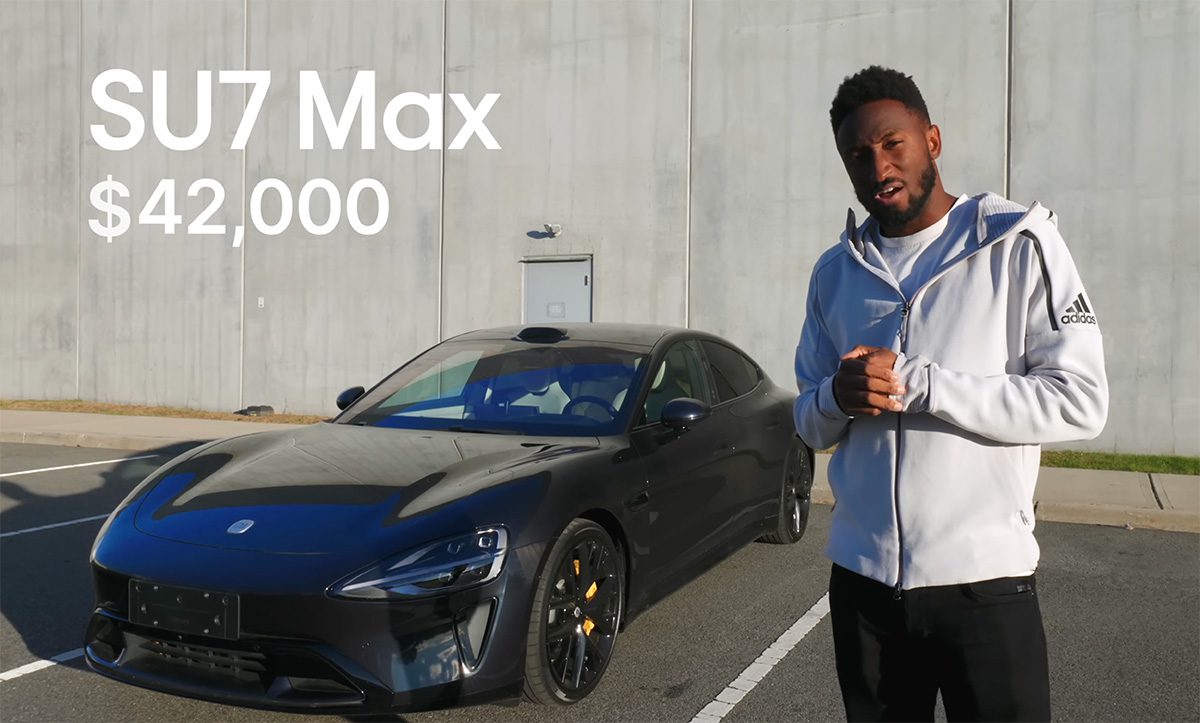
Marques Brownlee, a tech pundit with 21 million YouTube subscribers, posted a review of the Xiaomi SU7 in December, and it got some 10 million views. After Brownlee’s video came out, China EV Marketplace, an exporter of Chinese EVs, got 1,000 requests for price quotes from the US.
None of these potential orders can be filled, however, thanks to a combination of tariffs, regulatory issue and outright bans. In 2024, President Joe Biden imposed a 100% tariff on Chinese EVs. The US has also banned the import of cars with certain components made in China. But the biggest impediment to importing Chinese EV is regulatory. Chinese automakers haven’t designed their cars to meets EPA and DOT standards, so they can’t be insured or titled in the US.
Reuters recently ran an article with the clickbait headline “For the average price of a car in the US, you could buy 5 new Chinese EVs.” For the reasons cited above, this is wildly misleading. Sure, you could buy 5 of these cars—if you were in China. Automakers customize (or homologate) cars for different markets, and if and when Chinese automakers start producing cars to meet the US’s relatively stringent regulations, this will surely add costs. Automakers also set local prices according to what different markets will bear. Chinese EVs would probably sell like hotcakes in the US at prices slightly lower than those of comparable US models, so why would their makers price them 80% lower? Furthermore, as EV expert John Voelcker pointed out, the super-cheap models cited by Reuters are tiny subcompacts, which aren’t exactly popular with US buyers.
Will the US relent and allow Chinese automakers to sell their wares here sooner rather than later? Our current president has made contradictory remarks on the subject—in January he told a group of business leaders in Detroit that he would be open to allowing Chinese automakers to produce vehicles here in the US (as they’re already doing in Mexico, and may soon do in Canada). Democratic lawmakers and US auto industry groups have strongly urged him to abandon this idea.
What say the automakers? Geely, which owns EV brand Zeekr, has said that it is evaluating the US market, and may announce a decision in the next 2 or 3 years. BYD (which already builds electric buses in the US), says it has no plans to enter the US passenger car market. Xiaomi told Bloomberg it has no plans for US sales.
Well, whatever the Chinese may say, they seem to be laying the groundwork for future US sales. A Chinese automotive content platform called DCar has been courting American influencers. DCar, which says it is independent from the carmakers, paid to ship a selection of EVs to Alaska, and financed trips for several reviewers. Zeekr has also paid reviewers’ expenses (as automakers routinely do for media, including Charged) to test-drive some of its EVs in California. “While we love the positive reception from US reviewers, these collaborations are not a signal of an imminent US launch,” a Geely spokesperson told Bloomberg.
Forrest Jones, a US auto influencer with 8.9 million TikTok followers, told Bloomberg that he has worked with DCar, and also directly with Chinese automakers. Jones acknowledges that some consider showcasing Chinese EVs in America to be controversial, but thinks competition is healthy for the industry. “Even if we don’t get them here,” Jones told Bloomberg, “I would like consumers to know what’s out there and have that ammunition to demand more from the brands we do have access to.”
Source: Bloomberg



















 EV Engineering Webinars & Whitepapers


 EV Tech Explained