

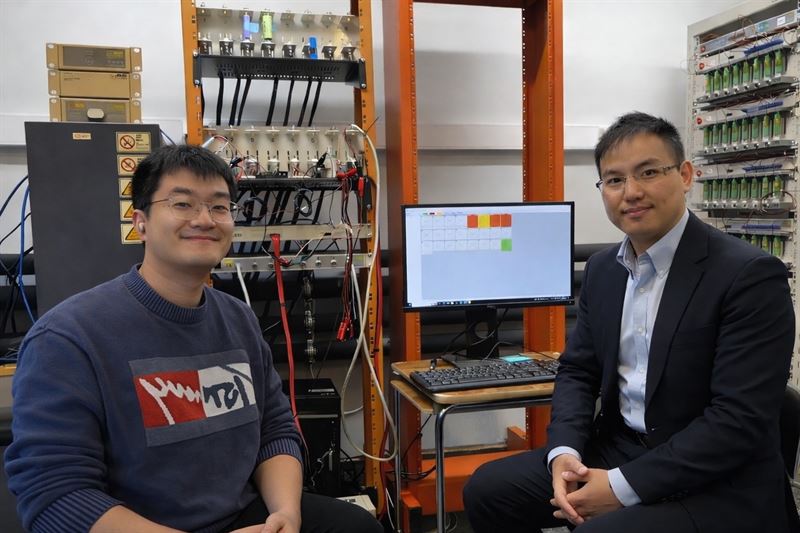
Researchers at Chalmers University of Technology have developed a reinforcement learning-based fast charging strategy that extends lithium-ion battery life by around 23% compared to standard protocols, with charging time affected by only a few seconds.
The method addresses a real problem with current practice: fast charging degrades batteries differently depending on their age, but today’s charging systems don’t account for this. The most damaging consequence is lithium plating—metallic lithium depositing on the electrode rather than intercalating correctly into the anode structure. This reduces capacity and can, in severe cases, cause a short circuit. The risk grows as the battery ages, yet standard protocols apply the same current and voltage to a new pack and a five-year-old one alike.
The Chalmers approach trains a reinforcement learning model to adapt charge current in real time based on two inputs: instantaneous state of charge and accumulated state of health. In simulation, using a model of one of the most common EV batteries on the market, the AI-controlled strategy extended cycle life—measured as equivalent full cycles to 80% of original capacity—by roughly 23% over the industry standard.
“We show that it is possible to charge more or less as fast as today, but with significantly less long-term degradation of the battery,” said Meng Yuan, now an assistant professor at Victoria University of Wellington and co-author of the study.
Deployment wouldn’t require new hardware. The strategy could be pushed as a software update to existing battery management systems, though it needs calibration for each battery chemistry. The team says transfer learning can speed that process, letting the trained model adapt to new chemistries without retraining from scratch.
Results so far are simulation-based. Physical battery validation is the next step. The study, co-authored by Changfu Zou, professor at Chalmers’ Department of Electrical Engineering, was published in IEEE Transactions on Transportation Electrification.
Source: Chalmers University of Technology



















 EV Engineering Webinars & Whitepapers
















 EV Tech Explained