



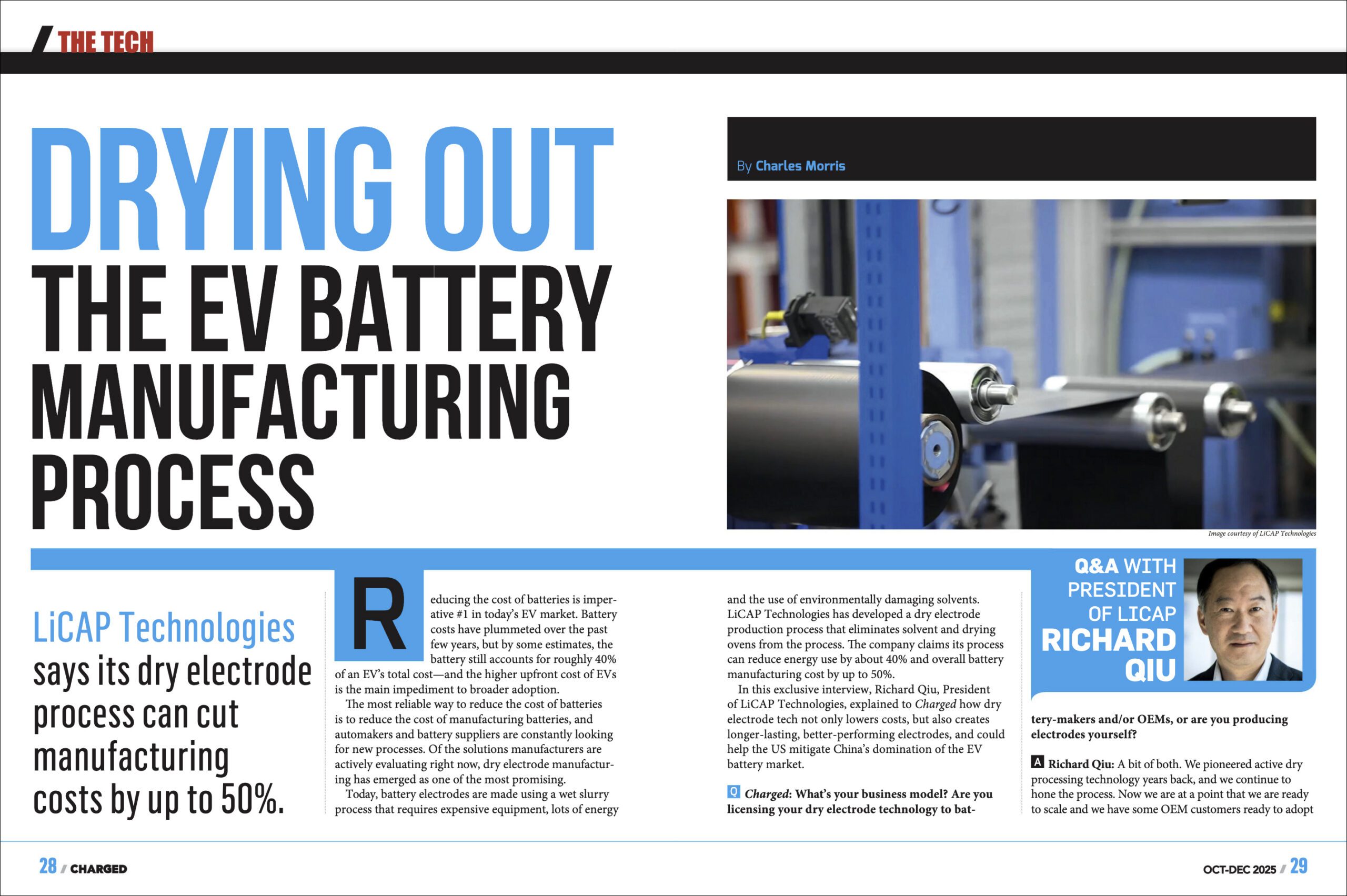
Drying out the EV battery manufacturing process.
Reducing the cost of batteries is imperative #1 in today’s EV market. Battery costs have plummeted over the past few years, but by some estimates, the battery still accounts for roughly 40% of an EV’s total cost—and the higher upfront cost of EVs is the main impediment to broader adoption.
The most reliable way to reduce the cost of batteries is to reduce the cost of manufacturing batteries, and automakers and battery suppliers are constantly looking for new processes. Of the solutions manufacturers are actively evaluating right now, dry electrode manufacturing has emerged as one of the most promising.
Today, battery electrodes are made using a wet slurry process that requires expensive equipment, lots of energy and the use of environmentally damaging solvents. LiCAP Technologies has developed a dry electrode production process that eliminates solvent and drying ovens from the process. The company claims its process can reduce energy use by about 40% and overall battery manufacturing cost by up to 50%.
In this exclusive interview, Richard Qiu, President of LiCAP Technologies, explained to Charged how dry electrode tech not only lowers costs, but also creates longer-lasting, better-performing electrodes, and could help the US mitigate China’s domination of the EV battery market.
Charged: What’s your business model? Are you licensing your dry electrode technology to battery-makers and/or OEMs, or are you producing electrodes yourself?
Richard Qiu: A bit of both. We pioneered active dry processing technology years back, and we continue to hone the process. Now we are at a point that we are ready to scale and we have some OEM customers ready to adopt our technology to do so. Because it takes quite a bit of time and effort to build a large-scale production line, we’re working with OEMs to license our technology. One of our partners, Dürr, the large equipment manufacturer, has licensed our technology to produce and install the equipment for the OEMs.
Our primary business model is licensing our technology for both the processing technology and the equipment. However, in the meantime, OEMs want to use our product to pilot, to test and to continue innovating. Before getting their large manufacturing lines installed, they want product from us, so we have a small manufacturing capability in Sacramento to produce dry electrodes for those OEMs.
Charged: Your process eliminates some steps in the traditional wet slurry process, saving money and complexity. Give us some more details about how that works.
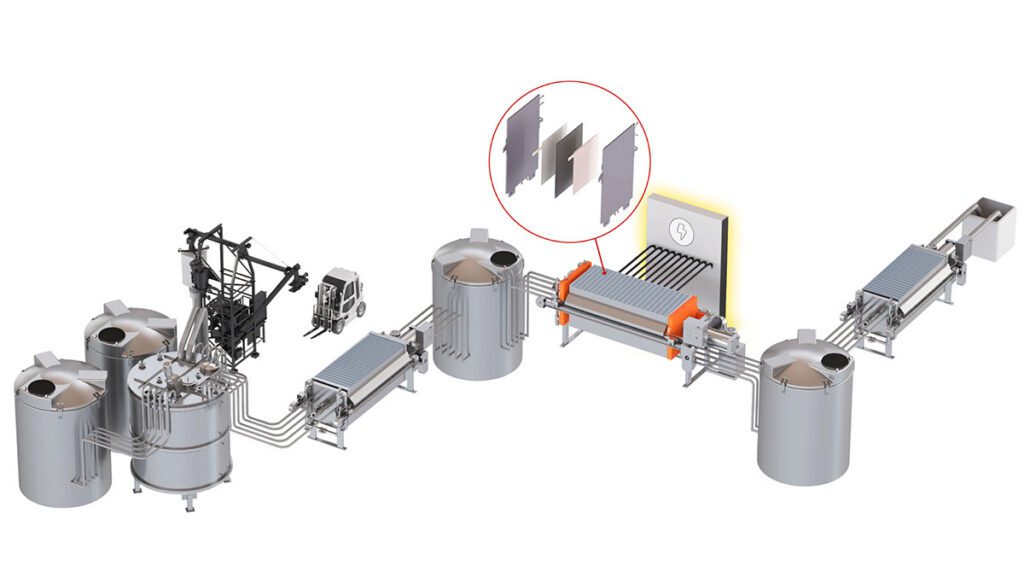
Richard Qiu: The traditional wet process primarily consists of five steps. That may not seem like too many, but it’s five gigantic steps, each with a lot of moving pieces. Obviously, you can improve each step, but the better way to improve the process is actually to eliminate some of those steps. So, we shrink the five steps into three steps, which substantially reduces the complexity of the process, as well as the size of the facility required to install the equipment.
The traditional wet process consists of five steps. We shrink the five steps into three, which substantially reduces the complexity of the process, as well as the size of the facility required to install the equipment.
We do a simple three-step process. In the first one, you mix the materials, you think about formulation, get the right binder and activating materials in there, and prepare for manufacturing. The second step we call the freestanding film. Then the last step is densification, calendering.
When you do wet processing, you put everything altogether along the way, but when we do our process, we produce freestanding film. One benefit of doing that is that you can produce different chemistries—that’s why we call our platform chemistry-agnostic. You just have to manage the mixing, make sure the chemistry works well and produce at the speed you want at the thickness you want to produce.
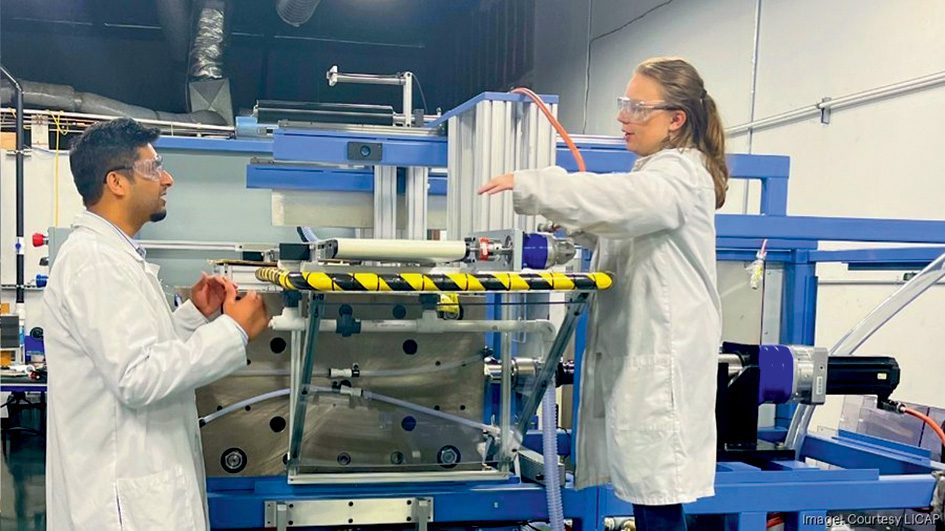
A key element of that is that any waste because of process irregularity or the edge of the film, you can 100% recycle, meaning that you will save tremendous amounts of raw materials. As we all know, battery raw materials are expensive and they’re hard to find, particularly here in the US, so 100% recycling is tremendous.
And after producing the freestanding film, then you can perform densification based on the application, whether it’s EV, energy storage or another application.
Charged: Making the transition from the wet to the dry process sounds like it takes some time. Can you give us an idea of how far along in that process you are with some customers, and how long it might be before this process is actually being used on the production line?
Richard Qiu: Good question. We have two OEM customers that are adopting our technologies. First one is Cellforce, which is part of Porsche in Europe, and they’re working towards bringing a new high-performance car to market. They have some performance metrics they want to hit, but they are also thinking about cost savings. This is a greenfield opportunity—they’re building a gigafactory for that capability. We started working with them last year and we continue to help them fine-tune the different pieces.
The next project is our partnership with Nissan in Japan. We’re working together to develop new technology for a next-generation all-solid-state EV battery. We’ve been working with them for a couple of years, but we recently expanded our strategic partnership to jointly develop the solid-state battery. They already built a part of the plant in 2025. Now we are in the process of working with them to refine the technology, and also building a gigafactory, and we’re targeting production in 2028.
Now the question is, what if you already have a multi-billion-dollar investment in the wet process in place? We start to see people have those conversations about at what point they will convert from wet to dry. This is no different than any other technology adoption curve. You will always have better technology coming up, probably cheaper, better, faster. But what are you going to do? You have to switch to new technology.
We see a lot of interesting demand for greenfield opportunities. When you need to build a new facility, our technology makes it easier for people to do so, because incremental investment for CapEx is typically 50% of what you have to invest for the wet process. And the facility size probably shrinks by 60% and incremental OpEx is reduced by 60-70%.
Some of the process equipment can be dropped in. Some probably needs to be modified. Some won’t be needed at all—for example, large solution-drying equipment. And you’re going to use less energy. Sixty percent of the electricity used for electrode manufacturing is used in the drying process. We eliminate that. So, we are in the early stage for conversion projects, but we are in the middle stage in terms of doing new projects.
Charged: So, a greenfield project versus replacing an existing line, those would have two different timelines.
Richard Qiu: That’s right. I would say the greenfield projects will see earlier adoption than the replacement projects.
Charged: You say your process is chemistry-agnostic.
Richard Qiu: Our platform is typically more flexible than the wet process, because as you simplify the process, there are fewer things you need to adjust. From our perspective, it’s really two things. One is the chemistry and how you mix the materials. With freestanding film, you still have to adjust the chemistry, binder and activation, to make sure the film quality is there and the thickness uniformity is there, because the different materials have different characteristics—particle size, that sort of thing. But for us, it’s easier to adjust, and also easier to experiment to make sure we achieve the best process parameters so we can achieve the right production throughput.
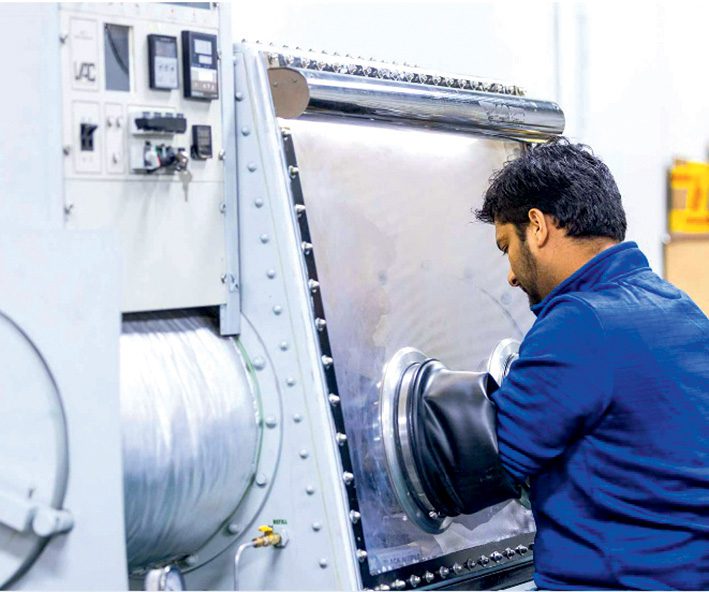
We have done that for more than half a dozen chemistries, because we’re working with different OEMs, different customers that have their different applications. For example, one of the major enterprises working with us here in US for an energy storage application, they use different chemistry and a different process, different thickness of the electrode.
Charged: Tell us more about your work with Nissan to develop solid-state batteries. Is that a separate thing from your production line innovations, or do they complement each other?
Richard Qiu: It is working together. For all-solid-state batteries, it’s a different, new chemistry, and some of the elements are sensitive to the environment, the temperature, that sort of thing, so you have to make them in controlled settings. The solid-state battery has very strong performance metrics and people really love it—fast charging and all this good stuff—but it requires a different manufacturing process.
Mass-scale production of solid-state batteries is not there yet. We are probably the first one working with Nissan to bring those barriers down, so we can mass-produce solid-state batteries by 2028. We start by choosing the right chemistry for the desired performance metrics, adding different materials, different binders, to make sure ionic connectivity is there, because that’s really the most key element for solid-state batteries. Then we have to think about how we can mass-produce them, and achieve the throughput we want to have. So it’s a very large, complex joint development effort. We have been working with Nissan for almost two and a half years. Now we’re scaling up.
Charged: Your process reduces costs, reduces complexity, and improves sustainability because you’re getting rid of the toxic solvents. You also claim to deliver performance improvements—higher energy density and power density. Tell us more about that.
Richard Qiu: In our process, we don’t use toxic solutions in drying out. Normally, with the wet process, when you dry a solution out, you take things out. For us, because we start out with the mixing technology activation, we can stretch materials, almost like cotton candy.
Initially when we thought about this, we thought about shrinking the footprint of manufacturing, reducing complexity, mostly from a cost and speed perspective. But as a result, because there’s no toxic solution drying out and we put the binder activation in that way, all those things actually make the materials stronger. Not to get into material science too deeply, but all those things result in stronger binding, so it creates better density and better ionic connectivity.
Now, we don’t really talk too much about the performance improvement, because today the industry is really focused on cost reduction. But we actually achieve both.
We don’t really talk too much about the performance improvement, because today the industry is really focused on cost reduction. But we actually achieve both.
Charged: Tell us more about recycling. You’re able to recycle all the scrap from the process. Is that something that other processes aren’t able to do?
Richard Qiu: If you don’t use freestanding film, it will be really hard to recycle because as you produce the electrode, you laminate other materials to the electrode material. To recycle, you have to peel those other layers back. People do recycle, but it takes another investment, another set of complex equipment to strip the materials back and recycle. And normally you won’t be able to recycle all of them. But for us, the freestanding film before densification is almost like the raw material, so you can send 100% back to the feedstock. We don’t say 100% because people make arguments—we normally say 98 or 99%. So that’s one key piece.
The other piece is that when you produce the freestanding film at high speed, normally the edge is not all straight and you have to cut the edge. That’s part of the manufacturing process—you’re cutting the edge to make sure you have the right width for the application, and the material you’re cutting off goes back to the feedstock.
Charged: You have some competitors in this space. AM Batteries makes equipment for the dry coating process, and Tesla has been working on dry coating tech.
Richard Qiu: In 2019 Tesla bought a company called Maxwell Technologies. The founding team of LiCAP was actually the founding team of Maxwell. Maxwell was making dry electrodes for ultracapacitors, but Tesla bought Maxwell because they were thinking about adapting that technology to produce batteries. I think they are successfully doing that for anode production, a little less for cathode production. Tesla is really, really good at the mechanical side because they’re a car manufacturer, but a little less in terms of how you integrate the chemistry, process and equipment together.
I believe we are ahead of all this competition, in the best position to capitalize on this opportunity in the market. If you produce film at high-speed throughput—60 meters or 80 meters per minute—the film quality needs to be really strong, because of the tension adjustment and other things. And because of that, most people think about the process from the mechanical perspective, but they often forget that you have to have the right materials, right mix, right film, right binder, right activation, so the material can be stretched fast enough, but strong enough to produce the freestanding film.
I think that’s a really key piece for our technology. We have an integrated process—it’s not just thinking about the mechanical part of producing film, but also the front end, the mixing. A lot of companies talking to us have said we have the best mixing technology, hands down, in the industry.
Can you reproduce a machine? You probably can if you are a really good equipment manufacturer, but you also have to think about the chemistry, the materials, the additive, formula, mixing, all that stuff, and that’s a different animal. Our team is a combination of material science, chemistry and mechanical equipment guys, and we work together with an integrated approach, a very cross-functional team. Most companies out there, they focus on one, maybe two of these pieces, but we focus on all three together, and that’s unique.
This article first appeared in Issue 74: October-December 2025 – Subscribe now.












 EV Engineering Webinars & Whitepapers

 EV Tech Explained