




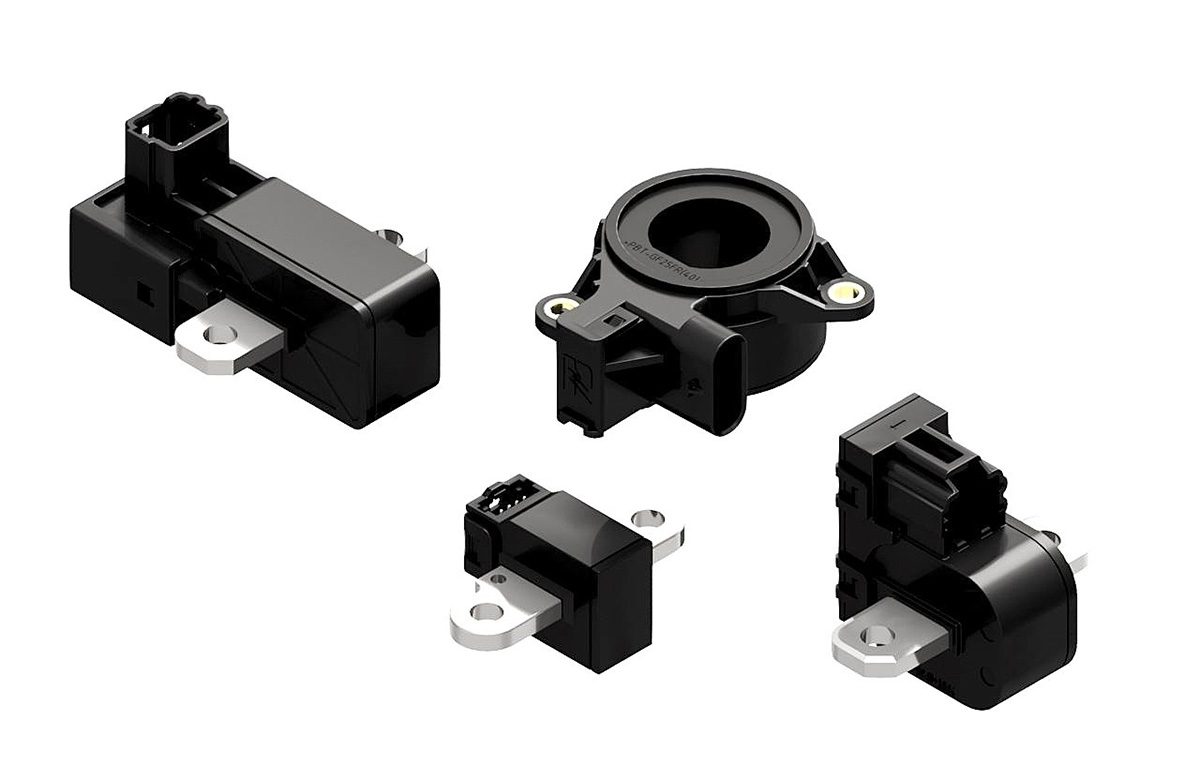
Littelfuse has announced a new family of six automotive current sensors, designed to deliver precise, isolated current measurement in electric and hybrid vehicles. The sensors, available as both analog-voltage and digital output devices, provide system flexibility for battery management, motor control and pyro-fuse safety applications in next-generation EV platforms, according to Littelfuse.
Utilizing open-loop Hall-effect technology, the sensors support bus-bar mounting in a compact form factor. Littelfuse specifies nominal current ranges up to ±1500 A, with minimized total error and low thermal drift. Certain models feature Controller Area Network (CAN 2.0B) communication and include AUTOSAR E2E Profile 1A diagnostics, as well as automotive safety integrity level C (ASIL-C)–capable current measurement for integration into safety-critical systems.
The new product range includes:
- Battery management sensors (CH1B02xB, CH1B032B, CH1B040B) for high-accuracy current measurement up to ±1500 A in applications like battery management systems (BMS), DC links, and high-voltage (HV) junction boxes.
- Motor control sensors (CH1B02xM, CH1P01xM), providing low-noise, ratiometric-analog outputs for inverter applications, supporting current up to ±1500 A (±900 A for CH1P01xM).
- Pyro-fuse trigger module (CH1B050P) for direct, microsecond-scale activation of pyro-fuses, claimed to be over three times faster than conventional approaches.
Systems designers can integrate these sensors into key EV and HEV applications, including battery management systems, motor inverters, HV junction boxes, power relay assemblies, starter generators, and both DC/DC and AC/DC converters. The busbar- or PCB-mount design, along with standard automotive connectors and support for CAN or local interconnect network (LIN) communications, allows drop-in replacement or adaptation in both new and legacy architectures, Littelfuse reports.
The sensors complement Littelfuse’s existing range of high-voltage circuit protection and power control components such as fuses, contactors, thyristors, and transient voltage suppressor (TVS) diodes, enabling system-level design for modern electric and hybrid vehicles.
Source: Littelfuse












 EV Engineering Webinars & Whitepapers














 EV Tech Explained