

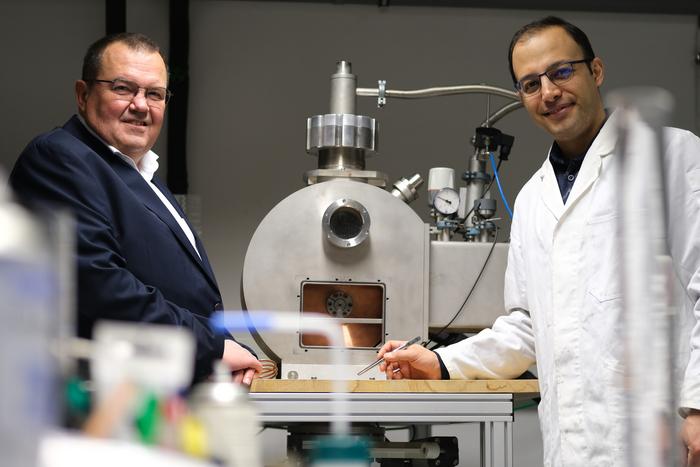
Researchers at Saarland University say they have developed iron-rich amorphous alloys for electric motor components that can reduce remagnetization losses by eliminating the crystalline microstructure that causes internal friction and heat buildup in conventional soft-magnetic materials.
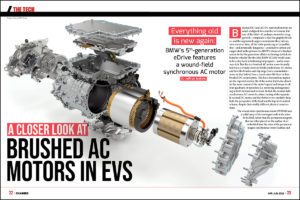
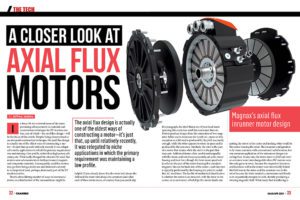
The project focuses on replacing coarse-grained crystalline iron alloys used in stators and rotors with metallic glasses containing 70% to 80% iron. According to Professor Ralf Busch, conventional motor losses rise as magnetic fields repeatedly reverse and force microscopic magnetic domains to reorient within a crystal lattice, creating hysteresis losses. In the amorphous materials, the lack of crystallites allows those magnetic regions to reorient more freely, which the researchers say dramatically reduces iron losses and heat generation.
The team says it identified three alloy compositions that resist crystallization while still meeting the requirements for additive manufacturing and motor use. The materials are processed by laser powder bed fusion, in which powder is melted with a laser and built up in layers about 50 µm thick to form fully amorphous motor parts without disruptive crystallites. The researchers say the approach could improve efficiency in devices such as e-scooters, drones and other small electric drives, while also avoiding critical alloying elements such as cobalt.
“The challenge now is to develop the process so that it works reliably in practice and at industrial scale,” said Professor Matthias Nienhaus. The work was carried out under the €3.5-million AM2SoftMag project funded by the European Innovation Council’s Horizon Europe Pathfinder Open program, with Heraeus AMLOY handling 3D printing of magnetic components.
Source: research-in-germany.org










 EV Engineering Webinars & Whitepapers



 EV Tech Explained