


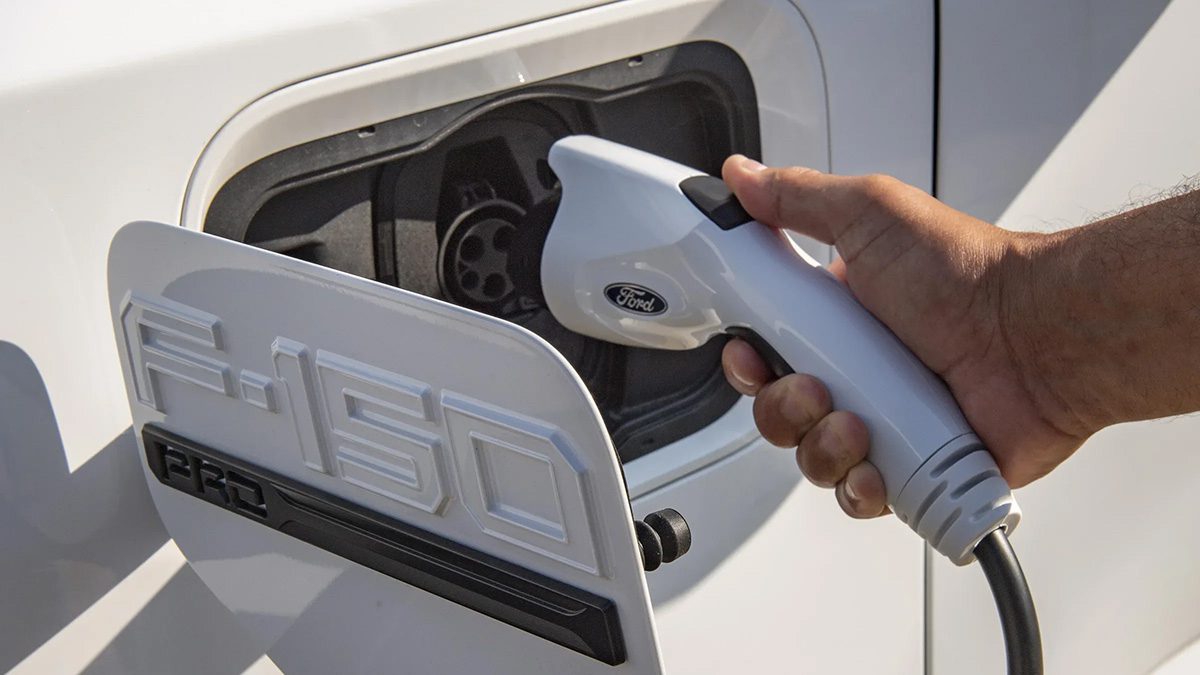
As expected, Ford has cancelled production of its F-150 Lightning electric pickup truck. Also no surprise to those of us who follow the industry: the company has issued a pair of press releases designed to frame the failure as a positive development.
And it may be—if the company’s goals are to shore up its bottom line, keep shareholders happy, and appease the regime in Washington. But if the goal is to win what CEO Jim Farley has called “a global competition with China,” then this is at best a strategic retreat.
This tidbit from the PR seems to sum up the change of direction at Ford: “The Tennessee Electric Vehicle Center is renamed the Tennessee Truck Plant.”
Petroleum-powered pickups are high-margin products for US OEMs, and EVs (to put it mildly) are not. As Clayton Christensen explained in his prophetic 1997 book, companies caught in The Innovator’s Dilemma often narrow their focus to concentrate on their most profitable product lines. Thus, US automakers are evolving into truckmakers.
Another thing companies in fading industries sometimes do is to double down on older technologies, for example building super-duper vehicles (clipper ships, articulated steam locomotives) to squeeze out a few more years of profits from traditional powertrains before they become obsolete.
We see Ford following a couple of versions of this path.
For the next generation of the electrified F-150, Ford is going to take a technological step backwards, adding a gas engine. The new F-150 Lightning EREV will offer “the best of both worlds,” says Ford. It will be a series hybrid, which, unlike a parallel hybrid, is always propelled by the electric motor—the gas engine acts only as a generator to charge the battery. This means the new truck will still deliver the instant torque of an electric powertrain, without the range constraint of a pure EV.
The big deal-breaker for an electric truck is that towing a trailer reduces range—a lot, sometimes as much as 50%. (The same is true of gas trucks, but gas stations are plentiful, fueling is faster than charging, and you can add an auxiliary fuel tank if you need one.)
Owners of the new F-150 Lightning EREV “will be able to drive 9 out of 10 days on electricity alone.” So, customers didn’t want the electric F-150 because it didn’t have enough range while towing, but they really, really want to drive electric when they’re not towing? And Joe Average Pickup Buyer only tows one day out of ten? And we’re sure he’s going to plug the thing in? Well, we’ll see.
Another part of Ford’s new strategy: lots more hybrids. “The company plans to expand gas, hybrid and extended-range electric options across its portfolio….nearly every vehicle [will feature] a hybrid or multi-energy powertrain choice by the end of the decade.”
This also represents a step backwards in time, in more ways than one. We remember when Ford electrified the Fusion, which was available in gas, hybrid and plug-in hybrid versions, and the C-Max, which came in hybrid and plug-in versions. Sales were middling slow, and Ford cancelled the cars after a few years. The “choice of powertrains” strategy is widely discredited in the industry today—adapting an ICE vehicle design to an electric powertrain sacrifices many of the advantages that a pure EV has to offer. Most of the folks we talk to agree that a “clean sheet” approach is the way to go. (This is no new revelation—a certain California startup figured it out back in 2012.)
So, is Ford waving the white flag to China, as InsideEVs’ Andrei Nedelea put it? Pulling the plug on EVs in order to follow Washington’s mood swings, as an eloquent commentor on Electrek expressed it?
Nay, fear not! Ford’s still working on the Universal EV Platform, a next-generation architecture “engineered to underpin a high-volume family of smaller, highly efficient and affordable electric vehicles designed to be accessible to millions of customers.” The first EV based on this platform is to be a midsize pickup truck that will begin production in 2027.
The breakneck speed of EV innovation is one of the reasons large OEMs are struggling to make money on EVs—more than one observer opined that the Lightning had already fallen behind the state of the art. Will the new platform enable Ford to catch up to the boys in Beijing? “Ford has bet its entire EV future on the new Universal EV Platform. It had damn well better be good,” says John Voelcker, who sat in on the media call and has several relevant observations on Ford’s news.
We’re still cheering for our home team, and we hope Ford hits it out of the park with the new platform, but what we’re hearing now sounds like the same song we hear from an OEM every time they cancel or scale back an EV program. They’re all committed to an electric future—but not yet, O Lord, not yet.
Sources: Ford (new F-150), Ford (EV-related losses), John Voelcker, InsideEVs, Electrek


















 EV Engineering Webinars & Whitepapers




 EV Tech Explained