




As a growing flood of off-lease EVs hits the market, and gas prices are at all-time highs, buyers are eager for used EVs—and prices have risen.
A previously overlooked corner of the EV market is suddenly having its moment in the sun. But the new kid on the block is…used?
New electric vehicles get a lot of attention—given their remarkable advances in 15 years, that’s understandable. But a growing number of drivers are finding that used EVs hit the sweet spot of capability, availability and affordability.
Used EV share of total sales rises
Many people don’t know that two and a half times as many used cars are sold in the US as new cars: 39 million used cars change hands every year vs the typical 15 to 17 million vehicles sold new. As cars last longer—S&P Global Mobility says the average model on US roads is now 12.8 years old—and rising prices make new vehicles unaffordable for more and more households, there’s little shame left to driving a recent car bought used.
More than 600,000 new EVs were leased from 2023 to 2025 to take advantage of the commercial-purchase loophole in the IRA. Their three-year leases are now starting to expire.
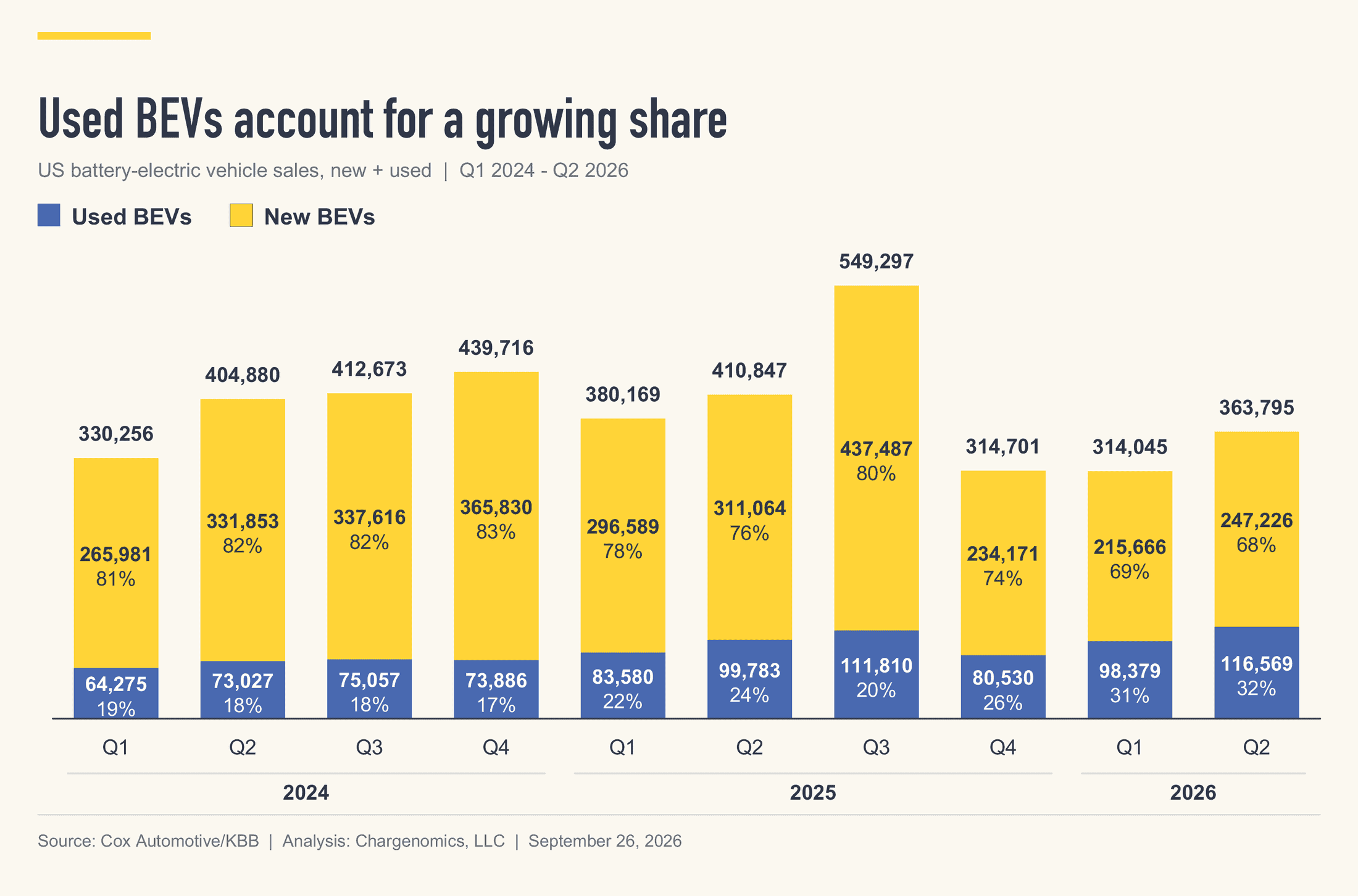
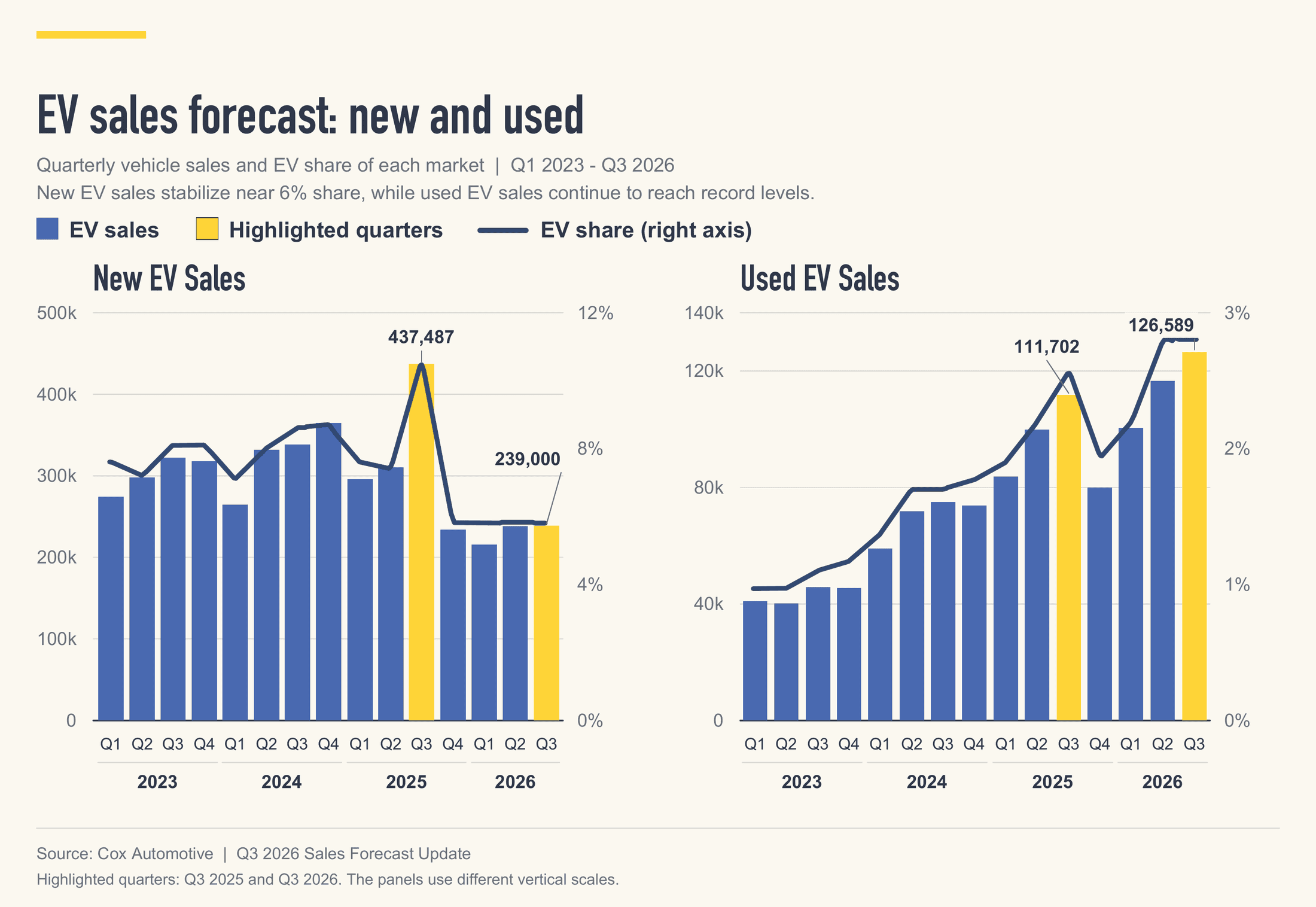
But EVs add a new wrinkle to the new-vs-used discussion. New EV sales have leveled out from the lows they hit after incentives ended a year ago—but used EV sales have grown for four quarters as a proportion of all EVs sold in the US.
CEO and Chief Analyst Loren McDonald of Chargenomics quantified the evolution. In the first quarter of 2024, 330,000 EVs were sold. Just 19 percent of those were used. The peak EV sales quarter, Q3 of 2025, when incentives were about to expire, saw a whopping 550,000 sold—20 percent of them used. But from April through June this year, a total of 364,000 EVs were sold—and the used proportion is now up to 32 percent.
Higher gas, more cars, lower prices
Two things came together to boost interest in (and lately the prices of) used EVs. First, more than 600,000 new EVs were leased from 2023 to 2025 to take advantage of the commercial-purchase loophole in the IRA. Their three-year leases are now starting to expire, dumping them back into the resale market. Most have fewer than 30,000 miles; some are below 20,000.
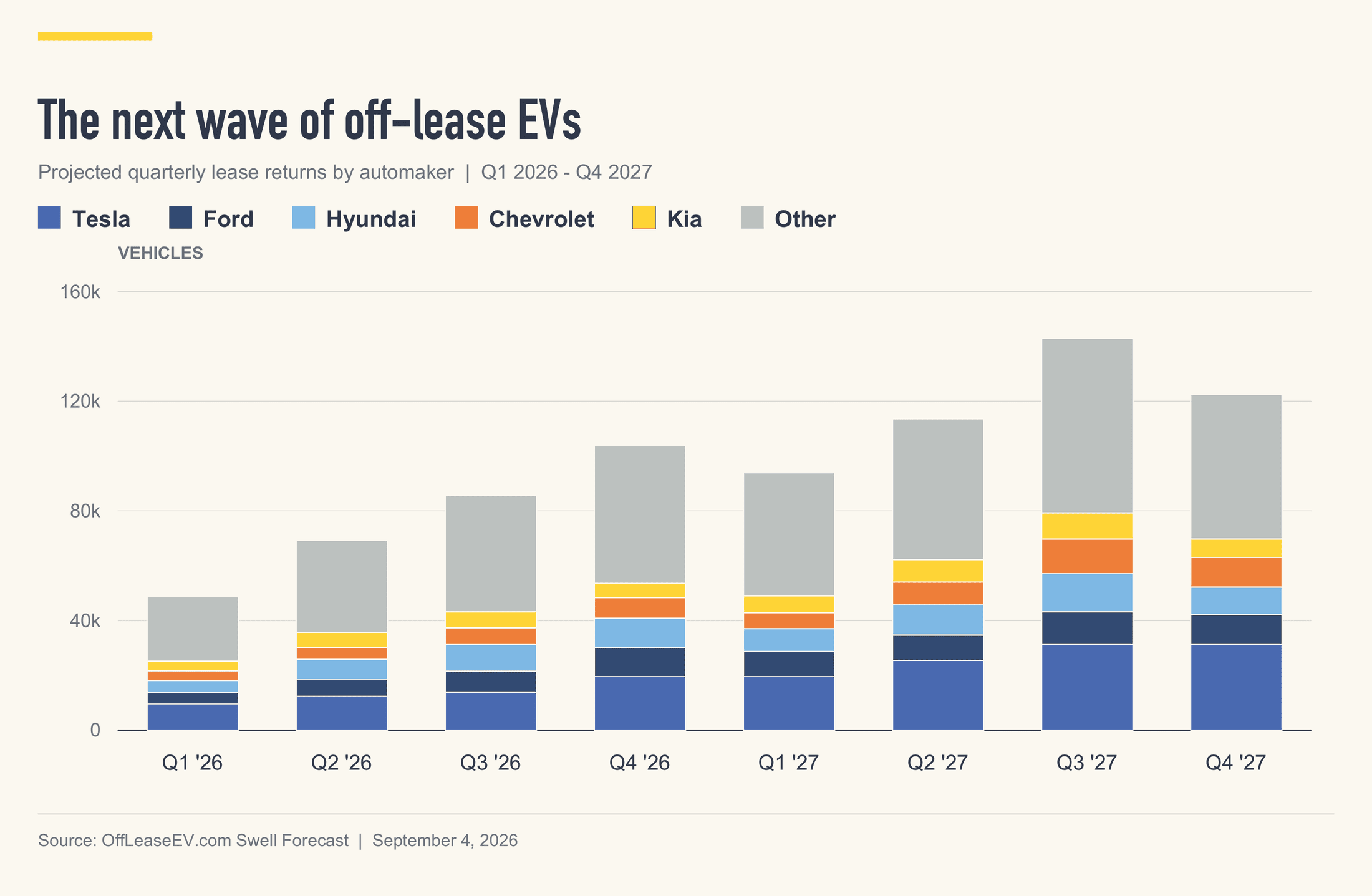
OffLeaseEV.com, a data website run by EV industry insiders, includes data on the number of vehicles entering the market. The number of lease-return EVs doubled from Q1 to Q4 of this year—more than 100,000 fresh off-lease electric cars are expected to hit the market this October through December. A further swell in EV lease returns will come in the third quarter of next year, 2027: nearly 150,000. An even greater swell will hit in 2028, as the last wave of leases from the second and third quarters of 2025 arrives.
Second, the most anti-EV US administration in history launched a war of choice, still ongoing, that has boosted fuel prices 40 percent or more in a matter of months. Drivers feeling the pain in their wallets when filling up likely have at least one friend, neighbor, coworker or relative who points out that it cost them the same amount to “refuel” when plugging in this month as it did in January.
The same depreciation that has been so painful for early EV owners can become a major advantage for the next buyer.
Fuel isn’t the only thing that costs more this year. The lack of affordable new vehicles has been an industry theme for a few years now, and the drumbeat has grown lately. It turns out that used EVs are a spectacular deal, because unfamiliarity among dealers and shoppers made them depreciate more—though that data is skewed because the reductions from government incentives aren’t reflected in the percentages. “The same depreciation that has been so painful for early EV owners can become a major advantage for the next buyer,” said Paul Waatti, Director of Industry Analysis at Autopacific.
People noticed, prices rose
Jimmy Douglas, founder and CEO of Plug, which supplies used EVs to dealers, offered more fine-grained detail in an interview with Charged. He pointed out that used EVs are increasingly being traded in and bought from franchised auto dealers rather than pure used-car outlets or EV specialists. By August, 59 percent of used EV sales went through new-car dealerships, up from 55 percent the month before.
Perhaps most interesting, while active listings for used EVs are steadily increasing (44,000 in August vs 37,000 in July), those EVs sold as fast in August as they did in February—42 days on average, per Cox Automotive—despite a far greater volume of EVs sold (30,879 in February, 44,350 in August, a 44 percent jump).
Perhaps most interesting, while active listings for used EVs are steadily increasing, those EVs sold as fast in August as they did in February—42 days on average, per Cox Automotive—despite a far greater volume of EVs sold, up 44 percent.
Douglas noted some standouts, including the Ford Mustang Mach-E (an average of 20 days to sell) and the now discontinued Ford F-150 Lightning (18 days). The bulk of used EV listings, he acknowledged, remained firmly in the Tesla category. The sheer sales numbers of the Model 3 (since 2017) and the Model Y (since 2020) ensure that they’re the used-car volume leaders by far.
Among other used EV models, Cadillacs do well, he said, as they’re bought by higher-end shoppers who want the premium EVs and are less focused on cost. Volkswagen ID.4s “sell like crazy,” in part because after six model years, earlier versions are inexpensive now. The Hyundai Ioniq 5 and Kia EV6 are at 21 and 18 days respectively. In fact, his data shows the top 8 used EV models by volume all sell faster now than they did before the Iran War began.

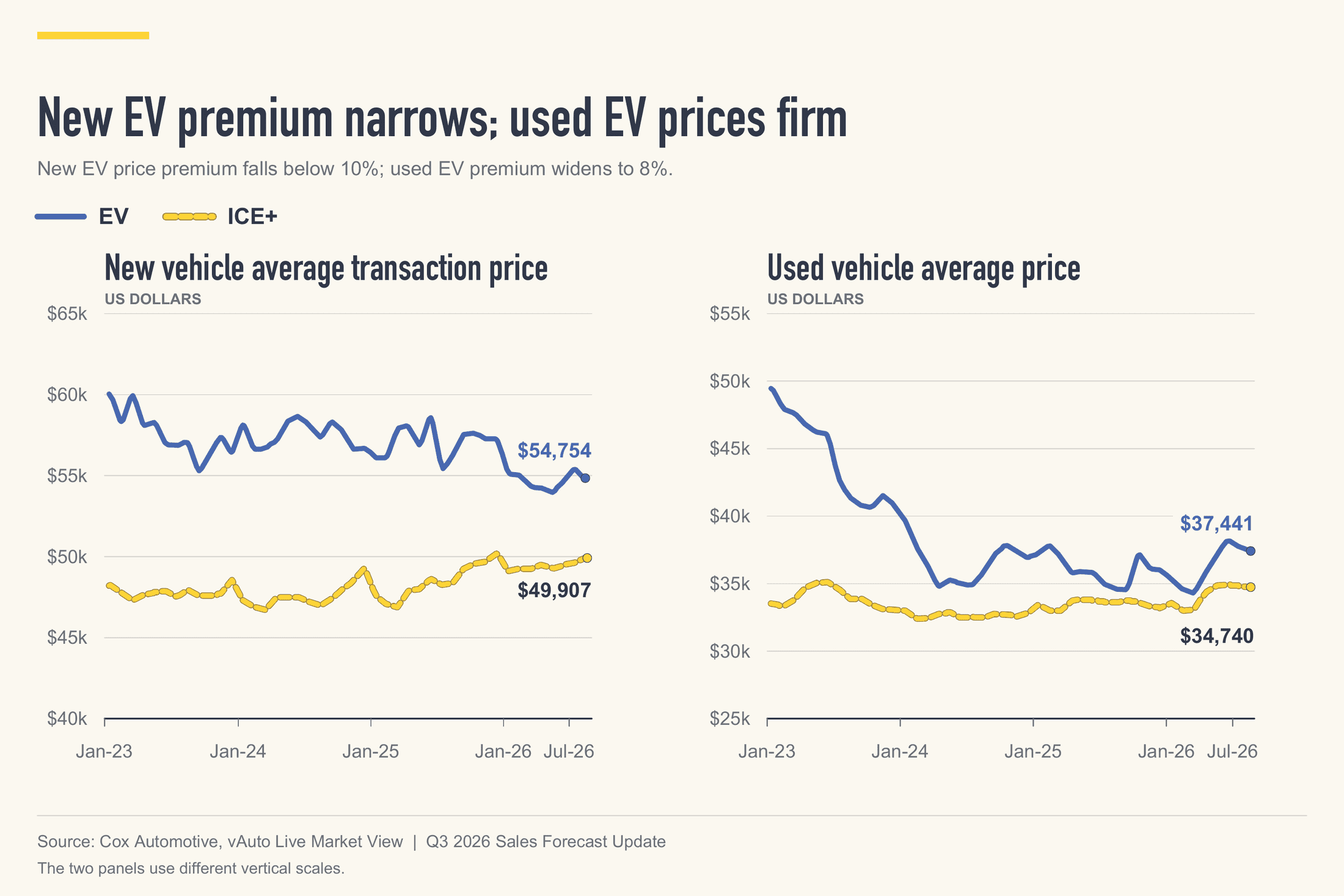
This demand spike has led, Douglas said, to a rise in used EV prices. Data from Cox Automotive shows that, while new EVs still cost roughly $5,000 more than the average price for all vehicles, average used EV prices—which had been trending toward parity—jumped 7.5 percent from February ($34,821) to August ($37,441).
Stephanie Valdez Streaty, Director of Industry Insights at Cox Automotive, discussed the phenomenon in the company’s Q3 2026 Sales Forecast Update Presentation. “Used EV sales continue to grow both sequentially and year over year,” she said.
More detail: “Used EV listing prices [were] up 8.2 percent year over year” compared to a roughly 3-percent rise for ICE vehicles. “That widened the used EV premium from 2.9 percent a year ago to 7.8 percent today. More off-lease EVs are entering the market, expanding the number of used EVs available to consumers, even as pricing remains firm.”
Battery health: no standard measure
Used EV listing prices were up 8.2 percent year over year compared to a roughly 3-percent rise for ICE vehicles.
Still, a major sticking point to buying a used EV remains the concern over battery life. While EV batteries are warranted against outright failure for at least 8 years or 100,000 miles in the US—and some makers warrant that energy capacity will remain at 70 percent or better within a given time or mileage—there’s no universal or standardized measure of battery health.
“Companies like Recurrent now track hundreds of thousands of cars,” said Sam Abuelsamid, VP of Market Research at Telemetry, “and their data shows that even at 100,000 miles, most EVs—except for older, air-cooled Nissan Leafs—still have at least 90 percent of their original battery capacity.”
“With 100,000-mile warranties on batteries,” he added, “buyers should have no concern about that aspect.”
While largely supporting that argument, other analysts added details that could suggest slightly more caution. Robby DeGraff, Manager of Product and Consumer Insights at Autopacific, notes that today, a battery’s state-of-health information isn’t easily available, and often requires plugging into the vehicle’s OBD-II port and downloading specialized software to analyze and interpret the signals.
How the vehicle was charged affects that health: vehicles recharged almost entirely via DC fast charging—those used for ridesharing or driven by owners with no access to overnight home charging—may be more at risk of battery degradation than those charged exclusively at Level 2 stations.
When Congress voted in May 2025 to kill California’s Advanced Clean Cars II program, a requirement in that act that would have helped future used EV buyers died with it. Starting with 2027 models, every EV would have had to display its battery state of health as a simple percentage figure. Every EV also would have had to warrant at least 70 percent remaining capacity after 8 years or 100,000 miles. Neither of those is required of any EV sold in the US today.
“Ultimately, a battery-health score may need to become as fundamental to the used EV transaction as the odometer and vehicle-history report are today,” adds DeGraff’s colleague Waatti.

Cheap new EVs vs cheap used EVs?
Ultimately, a battery-health score may need to become as fundamental to the used EV transaction as the odometer and vehicle-history report are today.
The present flood of off-lease EVs will continue through the first three quarters of 2028, reflecting the period when the EV leasing credit remained in place. So, you’ll likely hear more and more about used EVs, from buying guides to industry analyses.
Even as more affordable new EVs enter the market next year and beyond—think the 2028 Ford Fathom, the 2027 Kia EV3 or the current Chevrolet Bolt—they will face strong competition from heavily depreciated EVs just three to five years old. “Two- and three-year-old EVs are basically like new,” Chargenomics’ McDonald said, “but often carry a discount of $10,000 to $20,000 versus a current year of the same model.”
So, he suggested, “Automakers and dealers not only have to worry about compelling new and affordable EVs from competitors—in many cases their prime competition might be their own EVs coming off leases.” That could hit not just their current lineup but their less expensive entries to come. While some shoppers will only settle for a new vehicle, others may struggle to decide whether a brand-new Ford Fathom really represents a better value than a three-year-old, well-optioned Ford Mustang Mach-E if each stickers at $30,000 to $35,000.
Bright future for used EVs
In July, California Governor Gavin Newsom signed legislation (SB168) that launches a new incentive program for new and used EVs bought by first-time buyers. Used EVs will be eligible for an incentive of $1,750, compared to the $4,000 used EV federal purchase incentive that ended last September 30. For used EVs, there is no income cap for buyers, but eligible used vehicles’ sticker prices are capped at $25,000—except for vehicles made by companies headquartered in California. Among volume EV makers, that is largely restricted to Tesla, Rivian and Lucid.
California leads every other US state in its percentage of new EVs sold—roughly one in four new vehicles sold in the state has a plug. EVs are far more of a known quantity there, the state has mature public charging infrastructure, and it has not let up on its goal of reducing vehicular emissions—one it has pursued since the early 1960s.
In the end, Abuelsamid said, “While used EV prices have crept up since February, they are still a fantastic value compared to new or even used gas vehicles.” He added that he bought a used 2023 model last year. “It’s been great, and my wife never wants to go back to a gas car.”
It’s possible that sentiment may become a refrain among US households previously priced out of new EVs—or unwilling to drop new-car money on such a new technology. Those gas prices don’t look like they’re coming down any time soon—and more EVs come off lease every month.
This article appeared in Issue 77: July-September 2026 – Subscribe now.





 EV Engineering Webinars & Whitepapers








 EV Tech Explained