





Battery materials company NanoGraf has raised $65 million in a Series B funding round that was co-led by Volta Energy Technologies and CC Industries. NanoGraf had previously raised a total of $27 million from a mix of funding sources. NanoGraf’s technology enables battery-makers to incorporate more silicon into their anodes. Current EV battery anodes are… Read more »
Search Results Found For: "NANO ONE"
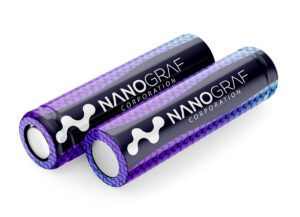
How NanoGraf is commercializing the “world’s most energy-dense” 18650 battery cell with stable silicon oxide
Q&A with NanoGraf COO Connor Hund Graphite, a pure form of carbon, is a critical material for battery anodes. Graphite’s physical structure allows it to store lithium ions, which merrily migrate to the anode when the battery is charged. Unlike cathodes, which can be composed of various combinations of chemicals (cobalt, nickel, manganese, lithium, iron,… Read more »
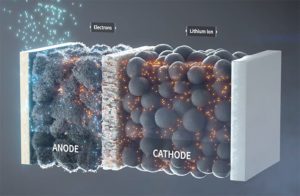
OneD raises $25 million in Series C funds, enters R&D agreement with GM
GM and OneD Battery Sciences will cooperate to research the possible use of OneD’s silicon nanotechnology in GM’s Ultium cells. Meanwhile, OneD has raised $25 million in Series C funding from investors including GM Ventures and Volta Energy Technologies. “Given a licensing business model and low operational costs, Series C funds will be used to… Read more »
NanoXplore acquires battery-related assets from materials manufacturer XG Sciences
Canada-based graphene company NanoXplore has purchased several assets from energy storage materials manufacturer XG Sciences, which ended operations in July of 2022. NanoXplore has agreed to purchase XG’s mechanical milling platform, R&D lab, all issued and pending patents, as well as its trademarks. “XG Sciences has a high-quality patent portfolio in strong end markets, and… Read more »

OCSiAl to build nanotube facility and R&D center in Luxembourg
Graphene nanotube manufacturer OCSiAl has received approval from Luxembourg authorities for a graphene nanotube synthesis facility to begin production in 2025, as well as an R&D center in Differdange, Luxembourg. The company’s graphene nanotubes are used by lithium-ion battery manufacturers. The company plans to invest $300 million in the production facility, which it says will… Read more »

Rheinmetall and PolyCharge form joint venture for NanoLam capacitors in Europe
Automotive and security technology firm Rheinmetall is setting up a joint venture company with capacitor supplier PolyCharge America to develop, produce and market PolyCharge’s DC-link NanoLam capacitors for automotive, military and industrial markets. Rheinmetall has also invested enough money in PolyCharge to hold about 13% of the shares in the US-based company. According to Rheinmetall,… Read more »
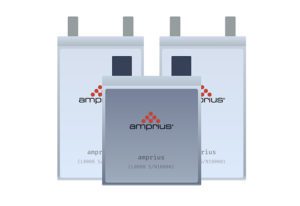
Amprius’s Si-Nanowire anode shortens charging time
Battery manufacturer Amprius Technologies is on a mission to reduce EV charging times. The company’s Amprius Extreme Fast Charge feature is enabled by its proprietary Si-Nanowire anode, which is thinner and lighter than conventional graphite anodes, and has much higher conductivity due to the high electrical continuity between silicon and the current collector. The Si-Nanowire… Read more »
OneD unveils new silicon-based battery technology
OneD Battery Sciences has introduced SINANODE, a technology to power the next generation of silicon-based EV batteries. The SINANODE process fuses silicon nanowires onto commercial graphite powders, which the company says triples the energy density of the anode while cutting its cost per kWh in half. The higher energy density increases battery range while nanowires… Read more »
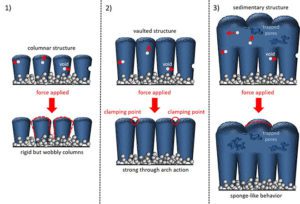
Silicon anode nanostructure could increase battery capacity and lifespan
Image caption: In the first stage, the silicon film exists as a rigid but wobbly columnar structure. In the second stage, the columns touch at the top, forming a vaulted structure, which is strong due to arch action. In the third stage, further deposition of silicon atoms results in a sponge-like structure. The red dashed… Read more »
Sila Nanotechnologies raises $590 million in funding
Sila Nanotechnologies, a maker of battery materials, announced that it raised $590 million in Series F funding at a $3.3 billion post-money valuation. The new funding comes as the first Sila Nano-powered batteries prepare to ship in consumer devices and the company scales up production. Sila Nano will use the funds to develop a new… Read more »