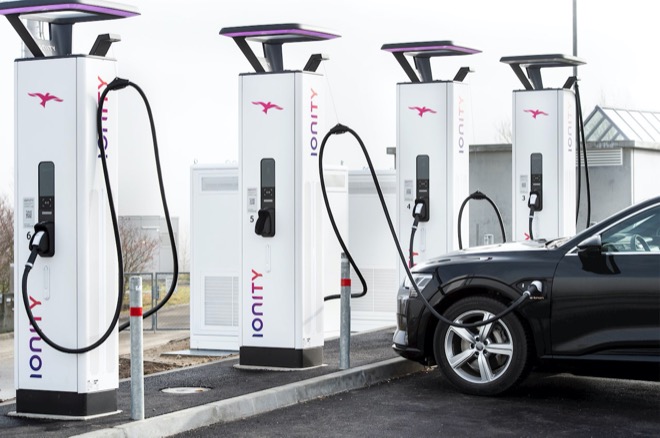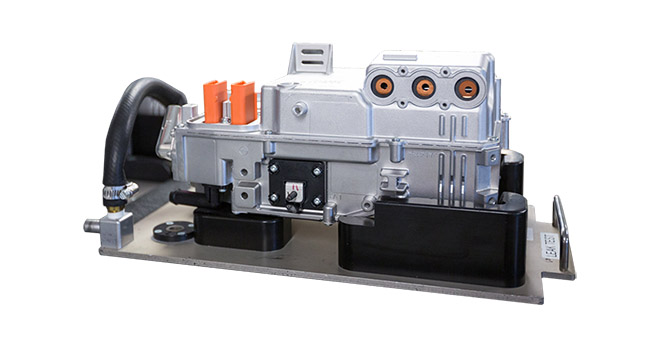





The new Fluke FEV100 Electric Vehicle Charging Station Test Adapter tests the safety and performance of Level 1 or Level 2 charging stations with type 1 connectors. The Fluke FEV100 simulates the presence of an EV, allowing technicians to test the charging station in combination with appropriate test instruments, such as digital multimeters and ScopeMeters…. Read more »
Newswire
BYD and Levo Mobility collaborate to finance and deploy up to 5,000 V2G-equipped EVs
BYD has partnered with Levo Mobility, a joint venture of Nuvve Holding, Stonepeak Partners and Evolve Transition Infrastructure, to integrate Nuvve’s V2G technology with BYD EVs. The companies plan to deploy up to 5,000 V2G-equipped EVs over the next five years. Nuvve’s V2G technology uses bidirectional charging stations to enable EVs to discharge energy from… Read more »
Northvolt to invest $750 million to expand Swedish battery lab
Battery manufacturer Northvolt plans to invest $750 million to expand its laboratory facility in Sweden in order to meet soaring demand for lithium-ion batteries. Northvolt says it plans to set up the “first R&D campus covering the entire battery ecosystem.” The order of the day in Europe is to quickly expand domestic battery capacity to… Read more »
Tesla expected to (finally) release a CCS adapter in the US
The War of the Charging Standards will only truly be over when any EV can use any public charging station. Tesla is taking another step toward that glad day by releasing a CCS-to-Tesla plug adapter to markets outside of Europe. When Tesla launched Model 3 and Supercharger V3 in Europe, it moved to make CCS… Read more »
The future of EV charging and liquid cooling components
Sponsored by CPC As the widespread adaption of electric vehicles continues to expand, increased charging speeds become critical. There are three levels of charging types, with the Level 3 charging as fast as 30 – 60 minutes. But drivers don’t want to wait. A fourth charging type is under exploration and could charge EVs to… Read more »
Atom Power to provide digital circuit breakers for NYC multi-family EV charging project
Atom Power has come up with a novel way to simplify charging stations, potentially reducing equipment and maintenance costs. Atom’s UL-listed solid-state digital circuit breaker centralizes the power management system—the smart technology that charges the vehicle resides in the electrical panel, and the charging pedestal or wall box does not contain high-tech electronics. Now technology… Read more »
How to improve battery testing efficiency and scalability
The battery pack is the single most costly EV component and has the largest impact on design and performance (size, weight, acceleration, range, charge time, and vehicle life). Join this session next week at the Charged Virtual Conference on EV Engineering, presented by NI and EA Elektro-Automatik, to learn how integrating EA Elektro-Automatik’s bidirectional, regenerative… Read more »
Tesla shows off new structural battery pack with 4680 cells at Giga Berlin
Tesla threw a party for the locals to celebrate the upcoming start of production at its Berlin Gigafactory. Kids of all ages dug the carnival rides, the giant Tesla coils shootin’ out sparks, and the obligatory pumpin’ sound-and-light show. For techies, however, the star of the show was Tesla’s new structural battery pack. A cutaway… Read more »
Indian ride-hailing and charging startup BluSmart raises $25 million in Series A funding round
Indian EV ride-hailing and charging company BluSmart has raised $25 million in a Series A funding round led by bp ventures, which invested $13 million. Other investors included Mayfield India Fund, 9Unicorns and Survam Partners. Sophia Nadur, Managing Partner at bp ventures, will join BluSmart’s board. BluSmart will use the new capital to expand its… Read more »
Simplifying EV traction inverters emergency power supply architecture
The low voltage power architecture used in EV traction inverters drives control electronics and provides gate driver power for the main traction IGBTs/MOSFETs. It must also provide redundancy to meet ASIL requirements. This requirement represents a special challenge as it means the Emergency Power Supply (EPS) must operate from low voltage and high voltage sources… Read more »