








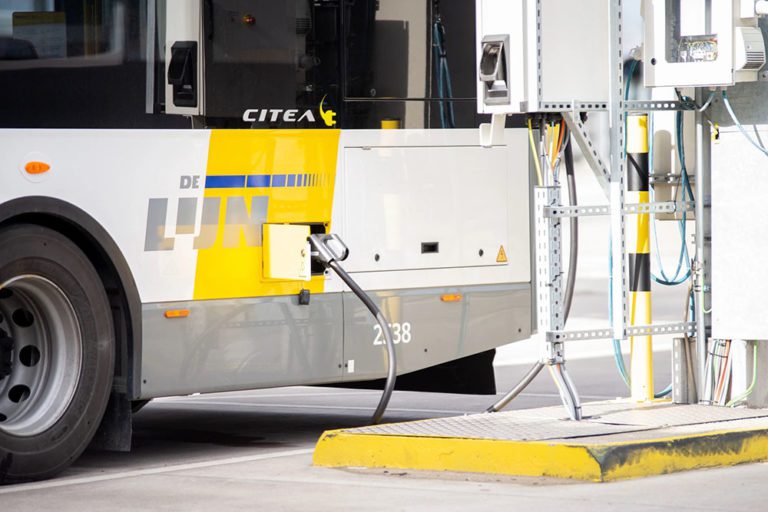
De Lijn, a public transport agency that serves the Flanders region of Belgium, operates a fleet of around 2,240 buses and 399 trams. The company plans to offer emission-free public transport by 2035, which means that approximately 2,100 buses and more than 50 depots must be updated. De Lijn recently installed an integrated depot and… Read more »
Search Results Found For: "CCS"

The promise of wireless charging: smaller batteries, longer battery life, fewer charging stations
Q&A with Momentum Dynamics Wireless charging is nothing new—Charged has covered wireless EV charging since at least 2011—but it may be that its true value is only coming into focus now, as more and more commercial and transit fleets are electrifying. There are many reasons (safety, reliability, liability) that a fleet operator might not want… Read more »

Epiroc to supply EVs for new all-electric mine in Canada
Epiroc, a Swedish manufacturer of mining and infrastructure equipment, has won an order valued at over 100 million Swedish Kronor ($9.7 million) from mining giant Glencore in Canada for battery-electric equipment and automation solutions that will be used at an all-electric mine. Glencore’s Sudbury Integrated Nickel Operations has ordered a full fleet of battery-electric equipment… Read more »
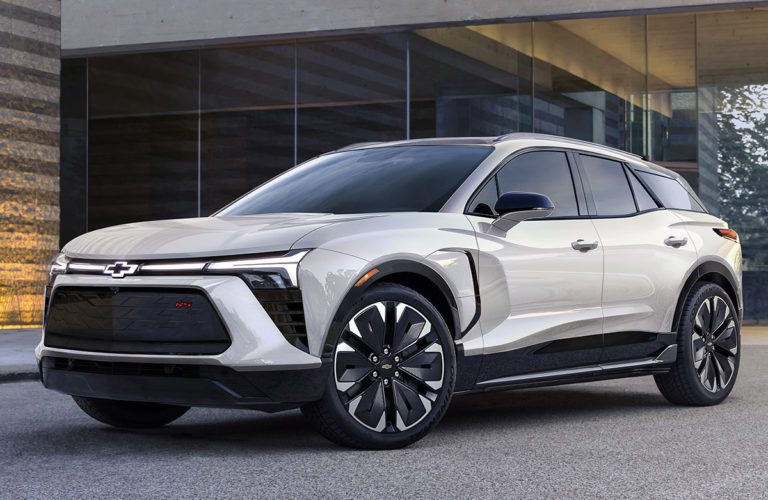
2024 Chevrolet Blazer EV: Chevy previews a mass-market electric SUV
Mid-size five-seat crossovers are a huge segment, and Chevy wants yours to plug in—next year. Chevrolet, it seems, doesn’t want to scare potential shoppers by offering up electric vehicles that stress too heavily the fact they’re … well, different. An advance preview of the upcoming 2024 Chevrolet Blazer EV suggested it’s very much a Chevy… Read more »

CharIN officially launches Megawatt Charging System for commercial EVs
Four years ago, the Charging Interface Initiative (CharIN), a global consortium with 280 members, including vehicle OEMs and EVSE manufacturers, established the Task Force for Heavy Duty Charging for Commercial Vehicles to develop a new standard for charging commercial EVs. Now CharIN has officially introduced the Megawatt Charging System (MCS), and demonstrated it using an… Read more »

Qualcomm’s new powerline communication device enables charging station-smart grid communications
Qualcomm’s next-generation powerline communication (PLC) device, the QCA7006AQ, is designed to enable CCS charging station communications. The new PLC device is based on Qualcomm’s QCA700X family of products, which have been widely adopted in EV on-board charging units and charging stations. The QCA7006AQ is compliant with the HomePlug Green PHY (HPGP) specification for vehicle-to-grid (V2G)… Read more »

Trends in EV charging capabilities
Sponsored by TTI and Phoenix Contact The growth of the electric vehicle market may feel inevitable: the focus on reducing CO2 emissions, the current political climate, investment by the government and automotive industry, and the ongoing pursuit of the all-electric society all point to a boon in electric vehicles. Until now, though, widespread adoption of… Read more »

WattEV aims to operate 12,000 electric Trucks-as-a-Service and a charging network to support them by 2030
Electrifying commercial vehicles is a critical part of reducing emissions, so it’s frustrating that the pace of fleet electrification has been so slow. Viable commercial EVs have been around for years, but fleet operators insisted on conducting years-long pilots to prove their reliability. Now that phase is over, and companies are starting to place substantial… Read more »
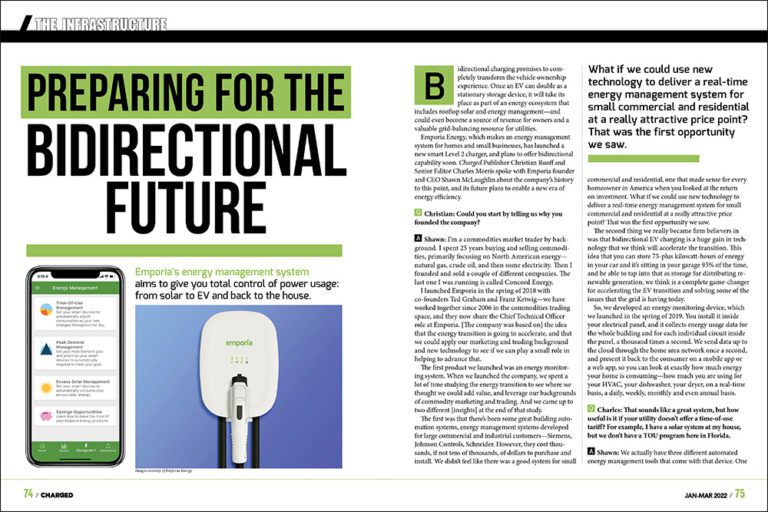
Emporia’s energy management system prepares for the bidirectional EV charging future
Total control of power usage: from solar to EV and back to the house. Bidirectional charging promises to completely transform the vehicle ownership experience. Once an EV can double as a stationary storage device, it will take its place as part of an energy ecosystem that includes rooftop solar and energy management—and could even become… Read more »

Looking closer at filter, resonant and snubber capacitors in EVs (Whitepaper)
Sponsored by Knowles Precision Devices Many power electronics today are being designed for use in high-temperature, high-voltage environments, such as inside electric vehicles. However, size, weight, and power (SWaP) are also key factors driving electronic product development. These conflicting design criteria are an issue for many electrical engineers because space is not available to simply add… Read more »